
Government Travel Solution on accepting stablecoin payments
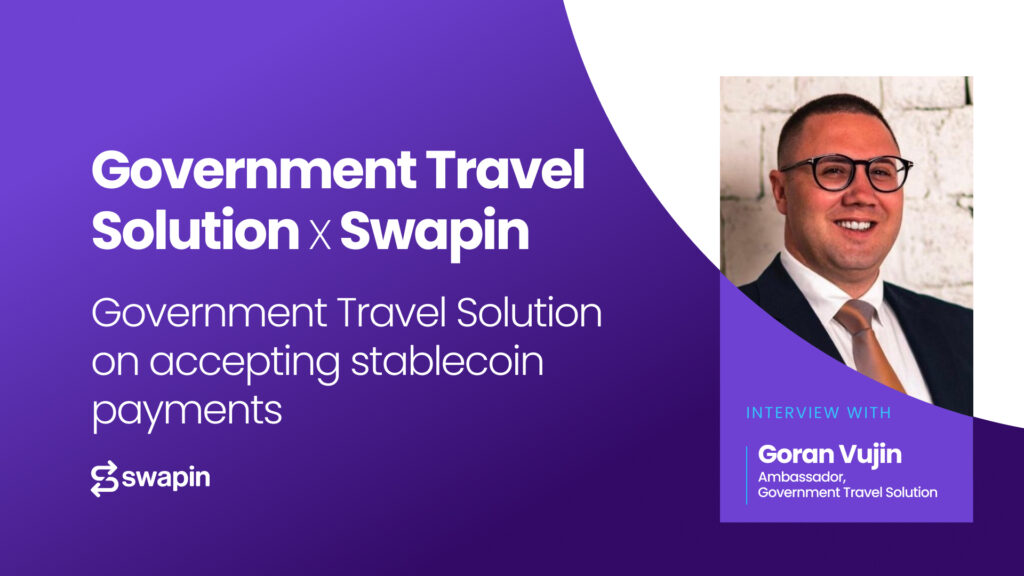
Our partner, Government Travel Solution, coordinates private jets, yachts, villas, ticketing, and ground logistics for governments, VIPs, and high-profile clients. Many of its requests come in at short notice, and its operations are set up to confirm bookings within hours.
That need for speed extends to payments. The Swiss company was among the earlier businesses in Switzerland to accept stablecoins, so settlement doesn’t hold up time-sensitive bookings.
In this interview, Goran Vujin, Ambassador at Government Travel Solution, explains how the team handles last-minute requests and what faster settlement changes on the operations side.
Story behind Government Travel Solution
Q: Why did you start the company? What did you see going wrong for this kind of client that made you want to build something around it?
Government Travel Solution was founded with one clear idea: to provide clients with everything they need from a single, trusted point of contact.
Throughout my career, I repeatedly observed the same challenge. Whether working in luxury hotels or as a chauffeur in our family-owned limousine company, clients did not simply want a service. They wanted someone they could rely on. They wanted a person who understood their needs, could answer their questions, make trusted recommendations, solve problems, and provide support whenever required.
My background is rooted in hospitality, where I had the opportunity to work through many different positions and understand the guest experience from multiple perspectives. This taught me that exceptional service is not only about providing transportation, accommodation, or logistics. It is about understanding the person behind the request and creating a seamless experience around them.
That experience ultimately inspired me to bring my knowledge of hospitality, transportation, and personalized service together in one company. Government Travel Solution was created to offer exactly that: one reliable partner who coordinates every detail, understands the client’s expectations, and remains personally available throughout the entire journey.
Q: Why build one company across jets, yachts, villas, and ticketing instead of picking one lane and going deep?
We chose to build one company across jets, yachts, villas, and ticketing because our team already brings deep, hands-on experience across these areas.
Our goal has always been to provide everything from a single, trusted source. For our clients, this means fewer interfaces, shorter communication lines, and significantly less room for misunderstandings or coordination issues. The more parties involved in a journey, the more complex the experience becomes. We wanted to simplify that.
By bringing these services together under one roof, we are able to understand the full picture of a client’s needs rather than only one part of the journey. This allows us to coordinate more efficiently, react faster, and deliver a more consistent level of service across every touchpoint.
It is also central to how we build long-term relationships. Our clients do not have to start from zero with a different provider every time they need a jet, a villa, a yacht, or tickets. They have one team that knows their preferences, understands their expectations, and can take care of the entire experience.
Q: Why this client group? What made you go after them specifically rather than luxury travel generally?
For us, it was important to have a clear focus. You cannot be everything to everyone and still deliver at the highest level.
We chose to focus on governments, VIPs, and high-profile clients because their expectations match very closely with our background and experience. These clients are not only looking for luxury. They need discretion, reliability, flexibility, fast communication, and someone they can trust.
That is exactly where we believe we can add the most value. Instead of positioning ourselves as a general luxury travel company, we wanted to build a business that is specialized around the needs of this particular client group.
Fast payment settlement for short notice requests
Q: Take us through what happens from the moment a request lands. Who moves first, what gets confirmed in what order, and how does that change when the trip is in a few hours instead of a few weeks?
We always say that last minute is one of our specialties.
Requests can come in by email, message, or phone. The first priority is always to understand exactly what the client needs and how urgent it is. Our reservations team receives the request and coordinates immediately with our sales team, which then takes over the actual arrangements and bookings.
When something is happening within a few hours, communication and coordination become even more important. There is no time to lose between different providers or unnecessary points of contact. Everyone involved needs to know immediately what has to happen next.
A good example happened just last week. The phone rang and one of our clients wanted a specific handbag for his wife. Our team immediately checked where the bag was available and contacted the brand. Because we have trusted contacts in different locations around the world, we were able to locate it in Paris.
We sent one of our shoppers to Paris, purchased the bag, and had it delivered to the client’s doorstep within 24 hours. And while we were arranging everything, our team even asked, “Would you like us to add a rose to make the gift complete?”
That, for me, explains how we work. Speed is important, but speed alone is not enough. It has to be fast, coordinated, personal, and precise. And again, this is where having everything from one source makes a major difference, because valuable time is not lost between different parties.
Q: What’s a request that sounds impossible from outside but is routine for you?
A few years ago, one of our clients, a prince, asked us for a video game that was not due to be officially released for several more months.
From the outside, that sounds almost impossible. But for us, the first reaction is never simply, “That cannot be done.” We look at the request, activate the right network, and explore every legitimate possibility.
In this case, we were able to make it happen and deliver the game before its official release.
That is quite typical of how we work. Our clients often come to us with requests where the normal answer would be no. Our job is to find out whether there is a way to turn that no into a yes.
Q: Where do things usually go wrong behind the scenes, in the part the client never sees? Most problems happen in the handovers and in situations that are outside anyone’s control.
For example, a chauffeur may be on the way to pick up a client and suddenly get stuck in unexpected traffic. The important part is not that the problem happened, but how quickly you react to it.
With fast and efficient communication, we can immediately reorganize the situation, send another chauffeur from our team, and make sure the client is still picked up on time.
Ideally, the client never even sees the problem behind the scenes. That is really the standard we aim for: solve the issue before it becomes the client’s issue.
Behind the operations
Q: How much do you need to know specifically about a client’s request to plan it properly?
It really depends on the client and the situation. Every request is different, and with government or VIP clients, a lot of information can come in at the very last minute.
For example, we recently had a client arriving by private jet. The only confirmed requirements were an armed bodyguard, a driver, and a four-hour booking. There was no final destination and no detailed itinerary.
In situations like that, flexibility is essential. We prepare everything we can in advance, make sure the right people are in place, and then adapt as the client’s plans develop.
Of course, the more information we receive beforehand, the faster and more efficiently we can plan. But our operations are built to work even when the details are limited or changing at short notice.
Q: Where do security requirements and comfort pull against each other, and who makes the call?
Security always comes first.
Of course, our goal is to make every journey as comfortable and seamless as possible, but never at the expense of safety. Especially with government officials, VIPs, or high-profile clients, there are situations where the most comfortable option is simply not the safest one.
In those moments, we work closely with the security team and the people responsible on the client’s side. They make the final call on security-related decisions, and our job is to adapt the logistics around those requirements while maintaining the highest possible level of comfort.
For us, good service means finding the best balance without ever compromising on security.
Q: What has to be in place before that week starts and how much prep time is needed?
One of the best examples is the World Economic Forum in Davos. During that period, we can have close to 500 people in operation across different functions like security personnel, butlers, chefs, housekeeping staff, chauffeurs, and other support teams.
Before that week even begins, the structure has to be absolutely clear. Everyone needs to know their role, the teams need to be briefed, communication channels need to be established, and all necessary materials and resources have to be in place.
With an operation of that size, you cannot start organizing once the guests arrive. The preparation begins well in advance, and the closer we get to the event, the more detailed it becomes.
Coming from hospitality, I always compare it to the kitchen: your mise en place determines the final menu. If the preparation is right, the execution becomes much smoother. Good preparation always pays off. Especially when you are coordinating hundreds of people and there is very little room for error.
Getting paid in crypto
Q: With clients across the globe, large amounts, short timelines, what did payment friction look like before crypto was an option?
You have to move with the future.
In the past, international payments were simply slower. Depending on the country, the bank, or the amount involved, there could be delays, additional checks, different time zones, or waiting periods before funds were confirmed.
For our business, that can be a real challenge because many of our requests are time-sensitive. Sometimes we are not talking about days, we are talking about hours, minutes, or even seconds.
Today, clients expect speed not only in the service itself, but also in the payment process. Crypto gave us another option to reduce that friction and make certain transactions faster and more efficient when time really matters.
Q: Why did you decide to start accepting stablecoins? Was there an existing demand from the client side?
We were one of the earlier companies in Switzerland to start accepting stablecoins because we saw where the market was heading.
For us, it was mainly about innovation and speed. Our clients operate internationally, often across different time zones and with very short decision-making windows. We wanted to offer a payment option that matched the way we already work: fast, flexible, and global.
There was also growing interest from the client side. Some clients were already familiar with digital assets and simply expected us to be able to accommodate that.
So for us, accepting stablecoins was not about following a trend. It was about making the payment process more efficient and giving our clients another practical option when speed matters.
Q: In a business built on speed, what does faster settlement actually change on your side?
Faster settlement means we can confirm services much quicker and move directly into execution.
In our business, that can make a real difference. If a jet, chauffeur, villa, security team, or another service needs to be secured immediately, we do not want payment processing to become the bottleneck.
The faster the transaction is confirmed, the faster we can finalize the booking, secure the supplier, and move on to the next step. In a business where minutes can matter, that efficiency is very valuable.
Future plans for Government Travel Solution
Q: Where does the business go next, more services or more depth in what you already do?
We live in a very fast-moving world. Trends come and go, but our goal is to build something that lasts.
For us, the next step is not simply adding more and more services. It is also about going deeper into what we already do and investing in the people behind the service.
That is why we are currently developing a new format: an academy focused on identifying and supporting talent from within the industry.
We want to pass on our experience, help develop the next generation of professionals, and create a strong standard for the kind of service our clients expect.
For us, long-term growth is not only about expanding the business. It is about building knowledge, developing people, and creating something that remains relevant for many years to come.
Q: What’s the part of the operation you still don’t have a clean answer for?
That is actually where I believe we are strongest: finding an answer when there is no obvious one.
Of course, not every request comes with a ready-made solution. But our mindset is always the same, we do not stop at the first “no.” We look at the options, use our network, adapt quickly, and find the best possible way forward.
So I would not say that we have a perfect answer for every situation from the beginning. What we do have is the ability to create a solution very quickly, even when the situation is unusual or completely unexpected.
That problem-solving mindset is really at the core of our company.
Get paid faster, across borders, without changing how you do your accounting. Only with Swapin.