
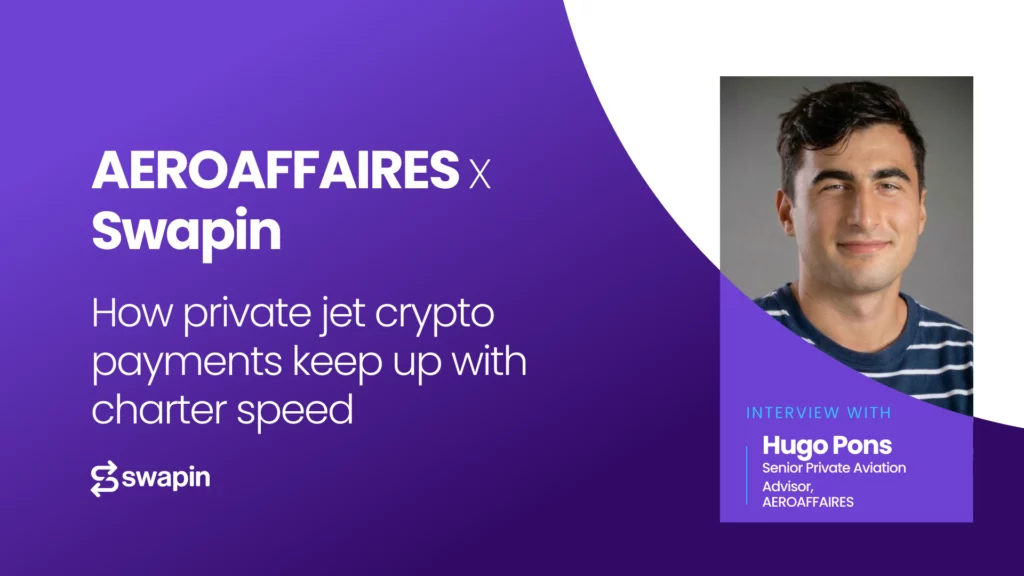
AEROAFFAIRES x Swapin: How private jet crypto payments keep up with charter speed
AEROAFFAIRES has been arranging private flights since 1991. Founded in Paris by François-Xavier Clerc, the brokerage works with more than 850 operators and cross-references over 20,000 aircraft to put together a single trip. It has flown 120,000 passengers through close to 8,000 airports.
For the last two years, some of those flights have been paid for in crypto. AEROAFFAIRES accepts private jet crypto payments through Swapin, so a client can pay in crypto while AEROAFFAIRES receives euros in its business bank account.
We spoke with Hugo Pons, private aviation advisor at AEROAFFAIRES, about who charters flights today, what first-time clients get wrong before they book, and why he thinks payment is the most fragile part of getting an aircraft off the ground.
Section 1: Behind the brand
Q: Who is actually chartering private flights today? Has that changed over the last few years?
Our clients all share one thing in common, of course: they are high-net-worth individuals. Among them you’ll find major business leaders, public figures, large corporations, and top-level athletes. That said, it’s impossible to draw up a complete client profile, because roughly three-quarters of our clients are completely unknown to the general public. They’re very discreet people and yet, they are often the ones who matter most.
Over the past few years, we’ve also noticed a real shift toward a younger clientele; the average age keeps trending down.
Q: What are the top reasons clients choose a private flight over a commercial one?
The number one reason is time but not just time as in minutes saved. When you’re running a company, negotiating a deal, or trying to be at your office in Paris for a board meeting the same evening you closed a meeting in Malta, every hour matters. Private aviation gives people back control of their own schedule.
Then there’s privacy. A lot of our clients are having sensitive conversations about a merger, a contract, a family matter and the idea of doing that in a departure lounge surrounded by strangers just isn’t an option for them. They have dedicated access for business aviation at the airport, so nobody sees them. On board, they can work, they can talk freely, they can even just switch off completely. That’s priceless for them.
And then, honestly, it’s about access. We can land where commercial airlines simply don’t go smaller airports, closer to where our clients actually need to be, sometimes cutting hours off a journey that would otherwise mean two connections and a rental car. For someone flying to a remote property, a factory site, or a private island, that’s not a luxury it’s the only way it works at all.
Q: Where is demand growing in terms of the kind of clients who book charter? Is there a specific region you see the most demand from?
What is exciting is that the client base is genuinely shifting. We’re seeing a lot more younger clients now, people in their twenties and thirties who built something quickly rather than inherited it. A huge driver of this is tech and SaaS: founders who have sold a company, or who are scaling one so quickly that commercial travel simply can’t keep up with the way they need to move.
In terms of geography the majority of our demand still comes from the US, that hasn’t changed. The Middle East remains extremely strong as well, that’s a very established market for us. But if you ask me what’s new, what’s really emerged over the last two years, it’s Eastern Europe. We have seen a clear and consistent rise in clients from that region, new wealth, new industries, and a growing appetite for the kind of flexibility and discretion that private aviation offers. It’s one of the most interesting shifts we have tracked recently
Q: What do first-time clients get wrong about private aviation before they book?
The biggest misconception is the price tag itself. People assume private aviation is only for billionaires, so they never even ask when in reality, for a group of six or seven people flying together, chartering a plane can end up costing roughly the same as seven business class tickets, sometimes less. They rule themselves out before they even get a quote, and that’s a shame, because for a lot of trips it’s simply the smarter option, not just the flashier one.
But then, on the flip side, too many people go the other way because they think there’s an empty leg available every single time, and that they’ll just get a flight for -70% off. The reality is very different: the probability of finding an empty leg that actually matches your aircraft type, your timing, and your route is extremely low.
The second thing people get wrong is timing. They think you can just call an hour before and hop on a plane like a taxi. In reality, especially for international trips, there are permits, slots, customs, and sometimes overflight clearances. It takes coordination. It’s not instant, even if it feels instant once you’re used to it.
Section 2: What the experience actually looks like
Q: AEROAFFAIRES works with 850+ operators and access to over 20,000 aircraft. How does that work out in real time when a client makes a request?
So this is really where the value of a broker becomes obvious. When a client sends us a request, we are not just picking from a small in-house fleet, we are instantly cross-referencing over 20,000 aircraft across our network of 850-plus operators. We look at what is available, where it is actually positioned, the aircraft type that fits the mission, the operator’s safety record, and of course the price, all in real time.
Within minutes, sometimes less for a straightforward route, we can come back to the client with several genuine options, not just one. That is the real advantage: we are not tied to a single operator trying to sell them whatever is sitting on the tarmac. We are comparing across the entire market to find what is actually right for that specific trip, that specific client, that specific day.
And then behind the scenes, once they choose, that is when the real work starts. We verify the operator’s AOC, the air operator certificate, and check the aircraft’s certifications. We also make sure the departure and arrival airports actually work for that aircraft: runway length, customs availability, slot restrictions, sometimes overflight or landing permits if it is an international route.
Q: Empty legs are the part of private aviation people actively search for. How do they work, and who are they genuinely a good option for?
Hugo: Empty legs happen when an aircraft has to reposition, for example after dropping off a client, and needs to fly back empty, or fly somewhere to pick up the next passenger. Instead of letting that flight go to waste, operators offer it at a reduced price, sometimes significantly reduced, because for them any revenue on that leg is better than none.
The catch, and this is where a lot of people get it wrong, is that an empty leg only works if it matches what you actually need. It has to match the right route, the right date, the right time, and the right aircraft type for your group. And that combination does not come up as often as people think. So they are genuinely a great option, but only for clients who have real flexibility: people who can adjust their travel dates by a day or two, who are not locked into one specific route, and who see it as an opportunity rather than something they are counting on.
For someone with a fixed board meeting or a wedding on a specific date, planning around an empty leg is risky. But for a client who simply wants to experience private aviation, or who has some flexibility in their schedule, it can be an excellent way to fly privately at a fraction of the cost.
Q: Some of your flights are urgent, including medical ones. What changes when a flight has to happen the same day?
Everything changes. The moment a request comes in for a same-day flight, especially a medical one, we do not have time to compare several options the way we normally would. We need an aircraft that is actually available and close enough to move within hours.
For MEDEVAC flights, there is another layer. We coordinate with medical teams, confirm the cabin can be configured for a stretcher, check the crew is trained for that kind of mission, and make sure the destination airport can receive a medical flight, sometimes with an ambulance waiting on the tarmac.
Also, on the payment side, it needs to be instant because there is no credit in this industry.
Q. What part of a booking is most likely to go wrong, and how do you protect against it?
The part that carries the most risk is payment. A lot of people assume the complications come from permits or weather, and those can play a role, but the real sensitive point remains financial. A flight can be confirmed, the aircraft positioned, the crew ready, and everything can still fall apart if payment is not secured in time. That is why we are extremely strict on this point.
We require payment before the flight, never after, and we verify every transaction carefully, especially on international payments, where banking delays or compliance checks can create real complications if they are not anticipated.
We also work only with solid operators, whose financial reliability is known, to avoid any risk of a last-minute cancellation on the provider side. We never book an aircraft until financing is confirmed. It is not a question of distrust toward the client, it is a question of protection, for the client as much as for us. In this business, a flight that is not paid on time is a flight that does not take off, and for clients who need to be somewhere at a precise hour, that is simply not an option
Section 3: Paying for a flight
Q: Charter flights aren’t small amounts and sometimes they need to be paid within hours. What did payment look like before crypto was an option?
Before cryptocurrencies, payments were made mainly by traditional bank transfer or by credit card. Bank transfer remained the preferred method for large amounts, but an international transfer can take several hours, sometimes a full day, which was a problem when a flight needed to be confirmed quickly.
Credit card payment was faster, but with its own limits: transaction caps, high fees on large amounts, and additional security checks. So we were constantly balancing speed and reliability, and that made certain urgent bookings more stressful than they should have been.
Q: Aeroaffaires has been accepting crypto payments for about two years with Swapin. What kind of client generally pays with it, and has that changed since you started?
The clients who pay with crypto are mostly younger, and especially entrepreneurs from the tech world, the same profile we talked about earlier when we discussed how the client base is shifting. These are people who built their wealth in a digital-first environment, so paying in crypto feels completely natural to them. It is not a novelty for them, it is simply how they already manage a large part of their assets.
Since we started accepting it about two years ago with Swapin, that profile has stayed fairly consistent, but the volume has grown. What started as a niche option for a specific type of client has become a real payment method we use regularly, and honestly, it fits perfectly with what we discussed about speed.
For an urgent flight, a crypto payment can settle far faster than a traditional international transfer, which for this generation of clients is exactly the kind of efficiency they expect
Q: What have you noticed about how crypto payments behave compared to a bank transfer?
The difference is striking, honestly. There is far less stress attached to the payment itself. With a crypto payment, it is instant. We do not have to deal with the bank, with opening and closing hours, with time zones, with any of the usual friction that comes with a traditional transfer.
Q: Has faster settlement ever made a flight possible that wouldn’t have happened otherwise?
Yes, absolutely, and I have a specific example in mind. A client contacted me at 2pm for a flight the next day, departing at 2pm, from the Netherlands to Morocco. Normally, we need 24 to 48 hours to obtain the Moroccan permit, so we were already working against the clock.
The client received the quote within 5 minutes and wanted to confirm immediately. The only issue was on the payment side. His Moroccan bank could not process an instant transfer, and paying by credit card meant a very high exchange rate, since we receive payment in euros. Using crypto solved both problems at once. It avoided the high fees, and thanks to how fast the payment settled, we were able to confirm the aircraft within 5 minutes.
That meant we could send the permit request almost immediately instead of losing hours on the payment itself, and in the end, we managed to get it in time for departure. Without that speed, this flight simply would not have happened.
Q: From the client’s side, does paying in crypto feel different, or is it invisible once it’s done?
For the client, it feels different, but in a good way. It is not something they even have to think about twice. They send the payment, and within minutes, sometimes seconds, it is confirmed on our side and the aircraft is secured. There is no waiting, no checking with their bank, no wondering if it went through.
Once it is done, it genuinely becomes invisible. The client stops thinking about the payment entirely and moves straight to thinking about the flight itself, the schedule, the details that actually matter to them.
That is really the goal. Payment should never be the part they remember about the experience. It should just work, quietly, in the background, so the whole process feels effortless from their side
Section 4: Future plans for Aeroaffaires
Q: AEROAFFAIRES has been doing this since 1991. What’s changed most in how people book private flights?
In the early days, booking a private flight meant phone calls, faxes, paperwork that took time, and clients accepted that as normal. Today, clients expect an answer in minutes, a quote almost instantly, and a confirmation the same day, sometimes the same hour. Technology changed everything on our side too.
We went from working with a limited, fixed network of contacts to instantly cross-referencing thousands of aircraft across hundreds of operators worldwide. Payments evolved the same way, from purely traditional banking to options like crypto that settle almost immediately.
But honestly, what has not changed, and what I think matters most, is the relationship itself. Clients still want a human they can call, someone who understands their situation and handles everything for them. The tools got faster, but the trust a broker builds with a client, that part has stayed exactly the same since 1991.
Q: What do you expect clients to start asking for that they don’t ask for yet?
I think the next big shift will be around sustainability. Clients do not really ask about it yet, but I expect that to change soon, especially with the younger, tech-driven clientele we talked about earlier. They already think that way in their businesses, so it is only a matter of time before they start asking about carbon offsetting, sustainable aviation fuel, or the environmental footprint of their flights, and expecting real answers, not just a marketing line.
Get paid faster, across borders, without changing how you do your accounting. Only with Swapin.