
How businesses accept international payments without delay
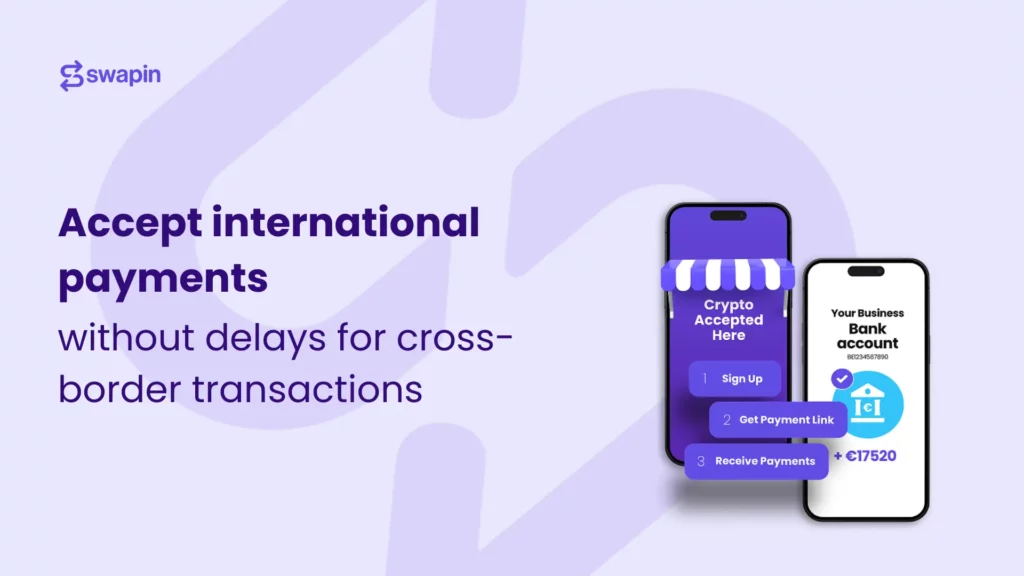
The fastest way to accept international payments now doesn’t go through the banking network at all. A stablecoin settlement moves the money straight from the buyer to a settlement provider, which converts it and drops euros in the seller’s account, usually in minutes, at any hour. Businesses moved about $226 billion this way in 2025, through B2B stablecoin payments, and a lot of it was money that couldn’t afford to wait on the wire.
Because waiting is what the wire does. Any business trying to accept international payments above a certain size runs into the same thing: the money leaves on time, then vanishes into a chain of banks for days, with no one able to say where it is or when it lands.
Why international payments get stuck between banks
The apps that move money across borders rarely mention how it actually travels. When the buyer’s bank and the seller’s bank hold no accounts with each other, and on most corridors they don’t, the payment can’t go straight across. It hops through correspondent banks that do, and each hop is a separate bank on its own schedule, running its own checks, with no particular stake in your deal.
Two things happen in that chain, and both cost you days.
The first is timing.
Every bank in the path has a wire cut off time, and anything that lands after it waits for the next business day. Stack a couple of those across time zones and a same-day instruction becomes a multi-day one. Most large payments don’t sail through on the first pass anyway. For B2B FX payments, the straight-through processing rate is just 26%, according to LexisNexis Risk Solutions. The other three in four get pulled out for manual handling, and manual is where the days go.
The second is review.
Send a large amount to a counterparty a correspondent bank hasn’t seen before and it can land in an anti-money-laundering hold, run by a bank in the middle of the chain that has no relationship with you, your buyer, or the deal, and no reason to hurry. The money is sitting somewhere you can’t see, on a clock you can’t check. That’s most of the real answer to how long a wire transfer takes to clear.
And the chain keeps getting longer. Active correspondent banking relationships dropped about 20% over seven years, per the Bank for International Settlements, as banks walked away from corridors where the compliance cost wasn’t worth the volume. Fewer direct links means more hops per payment, and better odds that one of them is a bank meeting your counterparty for the first time. The exact thing that triggers a hold is getting more common.
Why faster banks and other cross-border payment solutions don’t fix it
The instinct is to shop for a better bank. But a same-day product still rides the same correspondent rails, so it inherits the same cutoffs and the same holds. A nicer dashboard doesn’t take a bank out of the path.
Escrow is the other reflex, and it answers a different question. It parks the funds with a trusted third party until both sides meet their terms, which helps when trust is the issue. It does nothing for speed, because the money still has to arrive and leave over the same rails, twice.
How businesses accept international payments through stablecoin
The buyer pays in a stablecoin, a token pegged one-to-one to a currency like the euro or the dollar. A settlement provider takes that token, converts it, and pays ordinary euros into the seller’s bank account. The seller reconciles it like any other receipt and moves on.
The seller never holds, stores, or touches crypto. The token lives on the buyer’s side and inside the conversion step, and what lands in the account is fiat. The Federal Reserve says it plainly: payment stablecoins can settle cross-border value without the correspondent relationships that pile time and cost onto a wire.
This stopped being a fringe route a while ago. B2B stablecoin flows went from under $100 million a month in early 2023 to more than $6 billion a month by mid-2025, per Artemis, and B2B is now the biggest single use of stablecoins, around 60% of all payment volume. The businesses are settling deals and paying for goods faster than the wire would have.
Do stablecoin payments carry volatility risk
It’s the first thing any finance team asks, and it’s a fair question. The answer comes down to what kind of token you’re dealing with. A payment stablecoin is pegged to a fiat currency and backed by reserves, so a euro-pegged token is meant to hold at one euro, before the payment and after it.
The seller’s exposure is shorter still, because the token is converted to fiat the moment it arrives. There’s no position to watch and nothing crypto-shaped on the books at close. The risk people picture with crypto comes from holding it, and the seller here doesn’t hold it.
How the speed and cost compare to a correspondent wire
Speed is the easy part to see: minutes on a public network against one to five business days through the correspondent chain, with no cutoff window sitting in the way.
Cost is the part that hides. The World Bank puts the average cost of a cross-border B2B payment around 1.5%, and large corporations at 1 to 3% once you count every layer. The wire fee itself is the small stuff. The real money is in the FX markup baked into the exchange rate and the lifting fee each correspondent bank skims as the payment passes through. Skip the hops and you skip the skim.
What businesses need to accept stablecoin payments
Less than you’d think. There’s no wallet infrastructure to stand up and no crypto to manage. You need a settlement provider to handle the conversion, a bank account for the fiat to land in, and a way to hand the buyer a payment option, usually a payment link or an API call.
Swapin is one of the stablecoin payment providers building this rail, so a business can accept a stablecoin payment and get the balance as euros in its bank account.
The buyer gets a way to pay. The seller watches euros land. The part in the middle, the part that used to eat days, runs on a rail that never touches a bank that has never met either of them.