
Crypto to bank: how businesses move crypto into a bank account
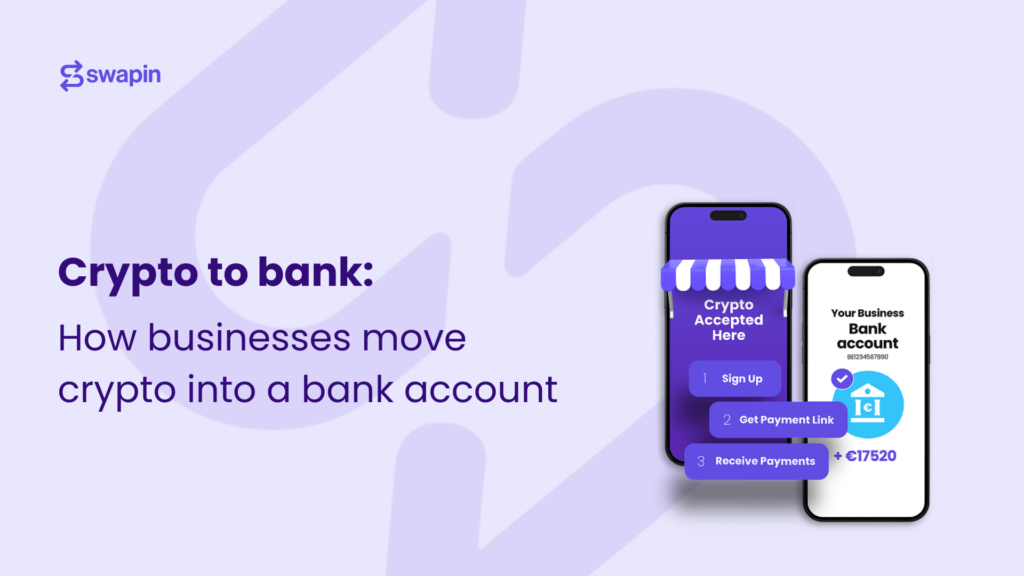
Moving crypto into a bank account through an exchange costs a business more than the fee the exchange quotes. Two of the bigger costs never show up on a statement: the spread taken on the conversion rate, and the price movement while the crypto sits waiting to be sold.
For a company that takes crypto regularly, that second cost is the one that stings. A payment invoiced at 10,000 euros can land in the bank as 9,850, or 10,120. Receivables aren’t meant to move like that, and reconciling the difference every month is work finance shouldn’t have to do. The standard exchange route makes the gap wider. Stablecoins, with the right settlement setup, mostly close it.
Can a business transfer crypto to bank?
Yes, though not in a single move. The crypto needs to be exchanged into fiat, then the fiat is withdrawn to the bank. On most exchanges that means three separate actions across two or three days, and the money isn’t usable until the last one clears.
Doing this once for a single payment is manageable. For a business settling client payments every week, each of those steps is a place where time or money leaks, enough that it rarely gets measured.
How the standard process works
Selling and withdrawing on a crypto exchange
Send the crypto to an exchange and then sell it for EUR, USD,GBP etc. Withdraw the euros to a linked bank account over SEPA. It works, and for small amounts it’s fine. However, at business volume it’s doing a job it wasn’t designed for.
How long does it take
The sale clears in seconds, but moving the euros to a bank is where the days go. SEPA withdrawals from an exchange usually take one to three business days, and exchanges often hold the balance for a verification window first. The euros exist before they’re spendable, and a payment stuck in transit can’t be reconciled or used to pay a supplier.
What it actually costs
The quoted fee is the visible cost. The spread is the quiet one: when an exchange converts crypto to euros, it takes a margin on the rate on top of the stated fee. Across dozens of settlements a month, that margin adds up to a figure that never appears on an invoice.
The delay compounds it. Every day the crypto sits unsold, its price can move, and the euros that finally land drift further from the amount invoiced. A faster path means a smaller gap, and the exchange route is one of the slower ones.
The accounting and treasury side
Every settlement has to tie back to an invoice, or someone has to explain why 10,000 went out and 9,850 came in. The Treasury has to know how much crypto the company is holding and for how long, because an unsold balance is market exposure sitting on the balance sheet. Run that through a personal exchange account and month-end turns into a manual reconciliation job on a paper trail that was never built for a company.
How stablecoins change this
Stablecoins aren’t a fringe experiment. They moved $9 trillion in adjusted payment volume in the year to October 2025, up 87% on the year before, according to a16z’s State of Crypto 2025 report.
A stablecoin like USDC or USDT is pegged to a fiat currency, so one unit is designed to hold its value against the dollar or euro. The two together make up roughly 87% of a stablecoin supply that now tops $300 billion, so a business is rarely asking a client to hold something obscure. When a client pays in a stablecoin, the price barely moves between payment and settlement, which is what closes the gap that Bitcoin or Ethereum opens up.
The amount received matches the invoice
When the payment is denominated in a fiat-pegged stablecoin, the figure invoiced and the figure that settles line up. Finance gets a clean match instead of a variance to investigate, which removes most of the month-end reconciliation work on its own.
You don’t hold crypto or manage an exchange
With business settlement infrastructure, the company doesn’t hold crypto or run an exchange account by hand. The client pays in stablecoin, and the equivalent fiat arrives in the business bank account.
Swapin, a stablecoin payment infrastructure platform, is one example built around this: a business accepts a crypto payment and receives euros in its bank, without touching a wallet.
The point is the category, not one provider. Once settlement runs on infrastructure built for it, crypto to bank stops being a task finance handles one payment at a time.
What to look for in a crypto-to-bank setup
A few things worth checking before committing to any approach:
- Whether the business ever has to hold crypto itself, or whether the setup converts it so the company only touches fiat.
- How fast fiat actually lands in the bank, measured in business days.
- How clear the fees and conversion rates are, including the spread, not just the headline percentage.
- Which currencies and stablecoins are supported, and whether they match the markets the business works in.
- Whether every settlement produces a clean, auditable record, because accounting will ask for it.