
Shaping the global luxury business landscape: Interview with Alexander Chetchikov
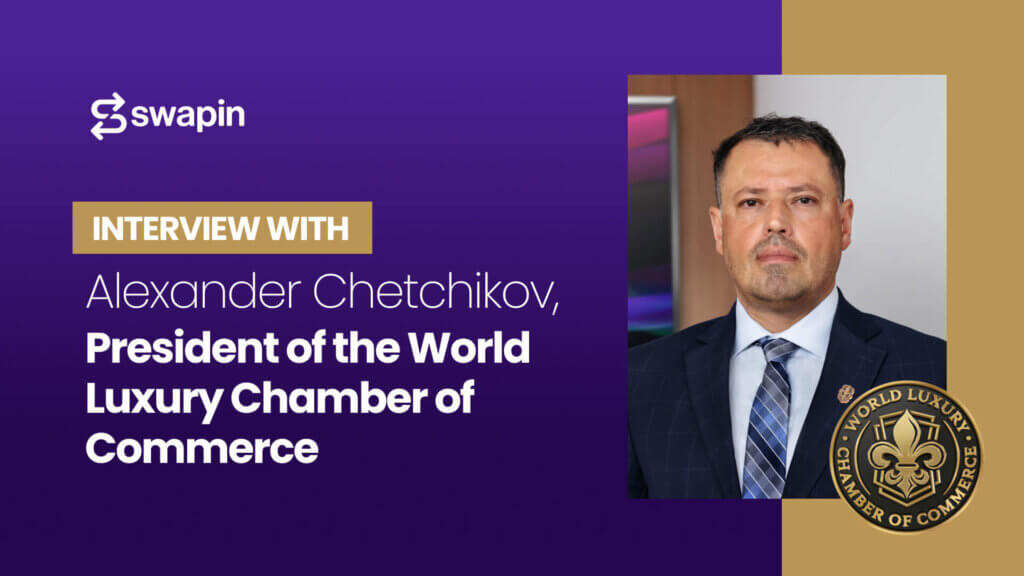
Earlier in October 2025, Swapin became a proud member of the World Luxury Chamber of Commerce (WLCC), a global network for leading luxury brands.
The WLCC provides its members a platform with exclusive access to elite networking opportunities, allowing businesses to scale and reach a wider luxury market.
The WLCC is built on the legacy of the Luxury Lifestyle Awards, with 16 years of honoring global luxury brands, boasting a network of over 5,000 luxury businesses across 100 countries.
We had the pleasure of interviewing the President of WLCC, Alexander Chetchikov, to discuss how the luxury business sector is at the forefront embracing innovation and expansion, evolving customer expectations, and predictions for the 2026 luxury business sector.
Behind the brand
Q: Alexander, in your own words, please describe the World Luxury Chamber of Commerce’s vision and mission, and its role in shaping the global luxury business landscape.
Alexander: Our vision is to become the largest global network for professionals working in the luxury sector. The primary goal is to unite the numerous, often fragmented segments of the global luxury market, acting as a catalyst for growth and deeper professional collaboration.
The Chamber provides brands with a strong platform for partnership and the exchange of valuable expertise. In this role, the WLCC shapes the global luxury landscape by creating a unified voice and shared standards for the entire industry.
To this end, the Chamber organizes and supports initiatives such as World Luxury Day and the Luxury Lifestyle Awards, which recognize and celebrate talent across the sector. Additionally, the WLCC conducts educational programs aimed at enhancing professionalism and knowledge, as well as hosting networking events that promote cross-border collaboration and meaningful exchange.
Q: Luxury has always been built on heritage, craftsmanship, and exclusivity. How do brands maintain these traditions while embracing innovation and technology?
Alexander: To preserve their essence, luxury brands today must skillfully balance age-old traditions with rapid technological change. They do not abandon their roots – a heritage, craftsmanship, and exclusivity – but rather use technology as a tool to amplify and showcase them.
This is evident in how digital platforms and AR/VR technologies create immersive stories about a Maison’s past, making its heritage accessible to new generations. In craftsmanship, innovations such as 3D printing or advanced materials expand creative possibilities, but the most valuable finishing touches always remain handcrafted.
Exclusivity is also evolving: it is now defined not only by rarity but by personalization – enabled by data – or by digital authenticity through blockchain and NFT technologies. These elements allow brands to remain desirable and relevant in an ever-changing global landscape.
Rising consumer expectations
Q: Consumer expectations are evolving. Convenience, speed, and digital experience are now cornerstones of luxury business. How are high-end brands adapting to this shift?
Alexander: Modern luxury brands understand that convenience, speed, and digital excellence are now integral to the luxury experience. They create omnichannel ecosystems that seamlessly merge online and offline interaction – introducing express delivery services, AR fitting rooms, and AI-powered instant support – ensuring that every touchpoint reflects the same level of refinement.
Q: How do you see instant payments improving exclusivity and premium service for customers expecting smooth, simplified solutions?
Alexander: Instant payments elevate the purchasing process, turning it into part of the impeccable luxury service experience.
Payment trends in the luxury sector
Q: Are payment expectations – speed, flexibility, and currency options – higher in the luxury business segment compared to other industries?
Alexander: Absolutely. Expectations around payments are significantly higher in the luxury sector. Clients purchasing premium goods expect the transaction process to match the quality of the product and service itself: instant speed, maximum flexibility (from traditional cards to cryptocurrencies), and freedom to choose the payment currency without friction.
Any malfunction, delay, or inconvenience disrupts the exclusive experience, undermines brand perception, and diminishes value in the eyes of clients who expect flawlessness in every detail.
Q: How do modern payment methods simplify cross-border and high-value transactions for international clientele?
Alexander: While I am not a payments specialist, from discussions with colleagues it’s clear that modern payment solutions are essential for simplifying cross-border and high-value transactions in the luxury market.
They bypass traditional banking complexities – reducing fees and delays – and digital wallets or blockchain solutions provide security, instant settlement, and transparency in currency operations. This aligns perfectly with the expectations of clients making significant international purchases.
Luxury market predictions for 2026
Q: What trends have you noticed in the luxury business industry in 2025, and which do you predict will accelerate in 2026?
Alexander: I don’t think 2026 will be radically different from 2025, but several trends are clearly gaining momentum:
- Hyper-personalization through predictive AI that anticipates future client needs.
- A complete merger of “phygital” retail, where physical and virtual experiences become seamless.
- The circular economy – resale and rental – becoming both a norm and a new status symbol.
- Growth of immersive, educational luxury experiences focused on learning and self-development.
- Increasing use of Web3 technologies for authentication and secure ownership records.
Crypto payments fit right into the luxury sector
Q: Crypto payment solutions have come a long way. How do they fit within the luxury business sector?
Alexander: From my perspective, crypto payment solutions integrate naturally into the luxury space because they combine instant settlement, confidentiality, and security – qualities essential for high-value purchases.
Adopting cryptocurrencies signals a brand’s progressive mindset and attracts a global clientele that values financial flexibility and transparency. Ultimately, crypto payments make the buying process more seamless, modern, and exclusive.
Making luxury brands, future-ready
Q: Finally, what does a “future-ready” luxury brand look like to you – one that stays timeless yet fully attuned to evolving customer expectations?
Alexander: A future-ready luxury business brand masterfully balances the preservation of timeless heritage – craftsmanship, quality, and exclusivity – with agile adaptation to new technologies and consumer behaviors.
Such a brand doesn’t merely adopt innovation; it integrates it thoughtfully into the customer journey, strengthening both image and relevance – especially among the new generation of luxury consumers.
A word from Swapin CEO & Founder
Evald-Hannes Kree, CEO of Swapin, shared his thoughts on the World Luxury Chamber of Commerce membershipWe became a proud member of the WLCC earlier in October 2025. Here at Swapin, we are seeing an increased demand for crypto payments in the luxury sector – from private aviation to chalets. Businesses now want to reach a bigger, wider consumer base that’s not restricted to one region. Crypto payment solutions help achieve that.
Together with the WLCC, we are able to connect with a network of leaders while shaping the future of payments for premium brands globally.
Curious about how your luxury business can access a global client base?
Reach out to us and book a free demo here to explore the possibilities.