
How mainstream crypto adoption is driving global business growth

Cryptocurrency’s trajectory from a valuable investment asset to payment method in less than two decades is impressive.
Not only are we seeing an increase in global crypto ownership, the technical and regulatory developments are driving mainstream adoption.
In this article we discuss the impressive crypto growth, key drivers that support expansion and adoption, and what it potentially means for businesses interested in accepting crypto payments.
How we got here: The road so far
From its first launch in 2009, cryptocurrency has been anything but linear. From paying for two pizzas with 10,000 BTC to using cryptocurrency as national legal tenders, the industry has come a long way.
In 2015, Ethereum debuted smart contracts and decentralised applications, laying the groundwork for the ICO boom in 2017-18. Soon ICOs became a popular method to raise funding. Crypto eliminated mediators and users could now invest in blockchain projects in return for tokens. In 2017, the crypto market cap reached $800 billion before crashing, further causing volatility in the sector.
From 2020 onward, mainstream crypto adoption began with companies such as PayPal, Tesla, and MicroStrategy entering the market and regulated exchanges and custody providers doubling down on security and compliance. This is also the time when DeFi gained traction as well as scrutiny from the regulators.
By 2024, it is estimated that over 560 million people globally owned some form of crypto. With 76% of crypto owners investing in Bitcoin, it remains the most popular cryptocurrency, and Ethereum ranking a close second with 54% of crypto investors owning it.
From 2024 onward, we notice a shift of focus from hype to building foundations. There’s a greater push for regulatory clarity globally. The EU’s Markets in Crypto-Assets Regulation (MiCAR) aims to set standardised regulations for issuers and exchanges across European states. Likewise in the USA, the GENIUS Act marks the first legislative step towards regulating stablecoins.
Looking at the trajectory so far, it’s safe to say cryptocurrency is now entering its real-world integration phase, where regulation, infrastructure, and practical use cases will be prioritised.
Key drivers pushing crypto adoption in 2025
Beyond the fact that crypto owners keep increasing globally annually, the following progress is likely to be crucial for mainstream crypto adoption in 2026:
Institutional investments: With companies such as Tesla, MicroStrategy, and PayPal making significant investments, crypto investments are now seen as legitimate assets. Launch of crypto ETFs by BlackRock in regulated markets further solidifies the legitimacy and expanding participation beyond retail.
Hedge against inflation: For countries facing high inflation and currency instabilities, cryptocurrency has proven useful. Many regions that currently have limited banking options, crypto payments offer them a faster and safer alternative to move money across borders.
Regulatory developments: As we discussed above, the last few years has seen a significant growth in regulatory growth across the globe. From USA’s GENIUS Act standardising stablecoins to EU’s MiCAR standardising regulations for issuers and exchanges, the shift to regulatory frameworks indicates crypto is no longer a niche, fringe asset.
Infrastructural improvements: Crypto use cases have now gone from being investment assets to payment methods. While crypto trading and investments are still going strong, more people now want to spend their crypto for everyday purchases. And crypto payment solutions have made it possible for users to make transactions with payment links and cards.
How the current market is adapting to crypto payments
The mainstream crypto adoption is increasing, driven by consumer demands and merchant integrations. The crypto payment apps market is expected to grow at 17-18% CAGR through 2033, signalling a strong long-term potential. Mainstream payment platforms are now incorporating crypto options. PayPal launched “Pay with Crypto” in the US market and Stripe now supports USDC payments via Shopify.
Merchants are now integrating crypto payment gateways into their platform to accept stablecoins and cryptocurrencies directly while receiving USD and EUR into their bank accounts.
The increase in adoption isn’t arbitrary, rather a measurable shift in user behavior.
The first half of 2025 saw a +337% growth in USDC payments and as per McKinsey, stablecoin circulation could reach $2 trillion by 2028. Merchants in emerging markets are increasingly switching over to crypto for cross-border payments due its speed and low-cost transfers.
The top three reasons cited for crypto adoption are speed (46%), global accessibility (41%), and convenient spending method (38%).
Based on these stats, it’s safe to say crypto is now entering the practicality phase where users want everyday payment solutions.
Implications for businesses
The current state looks promising for businesses deciding whether or not to accept crypto payments. Already in 2025, 64% of merchants mention a growing client interest in making payments with digital currencies with 85% expecting crypto payments to take over in the next five years.
It’s not surprising that many businesses globally are adopting crypto payments as a strategic differentiator to reach a wider client base.
Companies that integrate crypto as a payment option can tap into a growing, tech-savvy customer base and expand into global markets faster with more cost effective transaction solutions. The question now isn’t whether or not to take up this route, rather if businesses can afford to miss out on a crypto-friendly audience.
The sooner merchants adapt, the better equipped they are to meet customer needs – before competition catches up.
Here’s why businesses are opting for Swapin’s crypto payment solutions:
→ No need to manage crypto or hold a wallet. Our platform provides an all-in-one solution so you receive EUR in your bank account, every time.
→ No hidden cost for businesses so you always receive the exact invoiced amount.
→ Licensed payment services so you don’t have to worry about managing regulatory compliance.
→ Simplified account automatically converts all crypto payments to euro and processes with the request description. Thus, saving your accounting team from manual reconciliation.
→ No technical expertise or set up fee required, simply start accepting from day one.
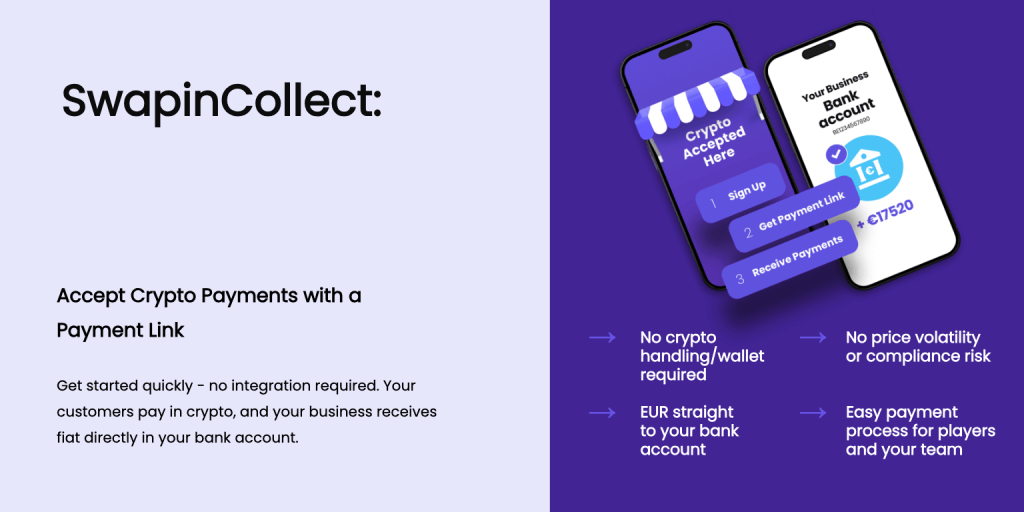
How swapin drives business crypto adoption
Companies across industries are accepting crypto payments. Here are the three partner companies who made the decision to expand their payment services with Swapin.
DRIVAR: Making luxury car rentals accessible
Leading luxury car rental marketplace, DRIVAR started accepting crypto payments so their high-end clients have the flexibility to pay with cryptocurrencies. SwapinCollect’s instant conversion feature allowed them to reach an international client base while still receiving funds in euros.
“At DRIVAR, we see a great demand in the field of crypto and blockchain technology. Customers repeatedly ask us if we offer crypto payments. Swapin seems to be the perfect partner for strategic positioning in this direction. We are happy to work together.“
– Christopher Kohn, Head of Marketing at DRIVAR

HBL: How accepting crypto made global expansion easy
As per the global lifestyle group, HBL, the luxury business domain is anchored in three principles: personalised services, global expertise, and seamless execution. So the natural next step was to offer their digitally-active clientele the option to pay with secure and globally accepted methods.
“Many of our clients, particularly those active in Web3, tech, and international business, are already managing wealth in digital assets. They want to pay in cryptocurrency to facilitate larger transactions in sectors where discretion and speed matter most. The challenge, until now, has been the lack of user-friendly, compliant, and secure solutions. That’s precisely why the Swapin partnership was so timely and strategic.”
– Hendrick Henningson, Owner at HBL

Yachthub Group: All inclusive yachting matches with crypto payments
Yachthub Group’s motto is to provide hassle-free, professional services to their client base. In 2024, the growing crypto-forward customer base led them to pursue the option and look for potential providers. When reaching out to Swapin, the requirement was for a practical and easy to integrate solution that allows them to tap into the wider luxury yachting market.
“Crypto payments will allow us to tap into a market that is still pretty much untapped in Malta and also internationally, especially when it comes to boating. We are confident that we will gain some customers that we were not able to attract otherwise.”
– Charlo Briffa, CEO of Yachthub Group

Crypto users in 2025 are looking for ways to spend their assets. They want practical solutions and businesses that make the strategic decision to integrate crypto payments, stay ahead of competition.
Reach a global crypto-friendly audience with Swapin
The question isn’t whether your business should accept crypto, rather if it can afford to lose out on the potential client base that wants to make payments with crypto.
With Swapin you can:
→ expand to newer markets
→ benefit from faster and cheaper transactions
→ attract crypto-friendly customers
→ modernise business payment solutions
Start accepting crypto payments today – book a free demo call here.