
How stablecoins simplify cross border payments for businesses in 2025
Stablecoins are a practical solution for businesses facing slow, costly, and complex payment systems. Pegged to fiat currencies such as USD and EUR, these cryptocurrencies hold steady value, offering businesses a simpler and cheaper cross border payments solution.
In 2025, the total adjusted transaction volume reached USD$6.7 trillion alone. Highlighting an interesting shift in business and consumer spending behaviour.
In this guide, we explain stablecoins, what makes them a practical alternative to traditional payment solutions, and how businesses can incorporate them into their payment strategies.
What are stablecoins and how do they work
Unlike other cryptocurrencies, stablecoins aren’t subject to the same level of volatility. It’s designed to hold steady value. Businesses can avoid fluctuating price loss and settle payments without any intermediaries and transaction fees, particularly in cross border payments.
Reserve-backed stablecoins are backed by real assets such as USD, EUR, or gold in a bank. Essentially, a $1 stablecoin is to be backed by $1 in these assets to maintain the steady value.
It creates an arbitrage loop, keeping the stablecoin close to its peg. The model depends on liquid reserves and transparent operations so that when it’s well maintained, the peg is stable.
On the other hand, algorithmic stablecoins use software to maintain value. Let’s say the stablecoin drops below $1, the system reduces supply and allows users to trade stablecoins for a redeemable bond-like token. If it goes above $1, the system mints additional coins to bring the value back down, creating a balanced supply-demand without a central custodian.
Stablecoin payments allow businesses to reach a global client base without any third-party intermediaries, save on exorbitant transaction fees, and settle invoices within minutes.
Stablecoins vs traditional payment methods: What’s better for cross border payments
Compared to stablecoin payments, traditional methods such as wire transfers, SWIFT, cards, and digital payments involve multiple intermediaries, high transaction and conversion fees, and slow processing time.
So while bank transfers can take 3-5 days and charge up to 12% transfer fees for international payments, stablecoin payments range anywhere between 1-2% and are settled in real time.
Reconciliation takes longer in traditional payments due to multiple banking partners and networks and often leads to errors. Stablecoin transactions are recorded on a blockchain network, reducing chargebacks and providing real-time transparency.
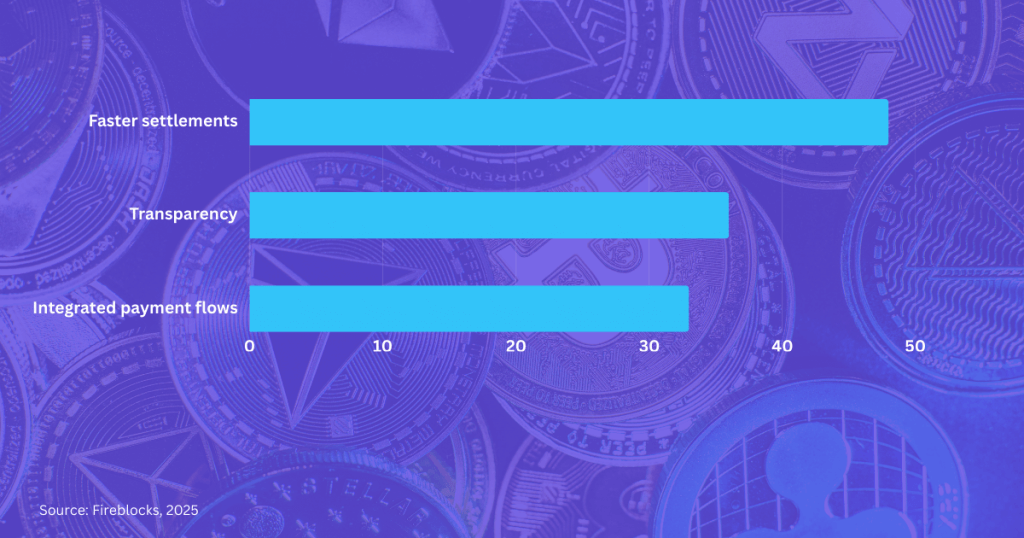
In a study conducted by Fireblocks, 48% of businesses cite faster settlements as the major stablecoin benefit. 36% cited transparency as the next major reason, and 33% voting for integrated payment flows and better liquidity management.
How businesses use stablecoins for cross border payments
What used to be a trading tool is now one of the fastest growing payment infrastructure thanks to zero intermediaries and instant settlements. And so far, stablecoins have been incorporated for the following use cases:
→ Cross-border payments for international businesses and suppliers.
→ Paying contractors and freelancers and settling invoices in minutes.
→ Automated and recurring payments services to reduce administrative overhead.
→ Payroll solutions to employees in regions with limited banking infrastructure.
→ Treasury management to maintain liquidity without exposure to volatile crypto markets.
→ Integrating with existing ERP systems for efficient reconciliation and reporting.
How to accept payments in stablecoins
Businesses can accept stablecoin payment with one simple solution: crypto payment links.
SwapinCollect is a payment link solution that allows businesses to receive payments in crypto from their users in two simple steps:
Step 1: The merchant creates a prefilled invoice that includes the payment link for a quick and easy transaction.
Step 2: After clicking on the link provided, the customer is redirected to the payment gateway to select their preferred payment method and initiate the transaction.
Step 3: The payment gateway verifies the payment details, checks validity and sufficient funds before authorising it.
Step 4: Once verified, the funds are deducted from the users account and a notification is sent confirming the payment.
Step 5: Once funds are transferred to the business’ bank account, the settlement can take anywhere between a few minutes to a few days, depending on the payment method.
How Swapin’s crypto payment link solution helps
Swapin offers a flexible and user-friendly solution for businesses looking to accept crypto payments through website or QR code.
→ Businesses don’t need to handle crypto or hold a wallet. Swapin provides an end-to-end solution. Simply receive funds in your bank account and focus on scaling business operations.
→ No hidden fees. Your client pays the transaction fees, meaning there are no extra costs to your business. You’ll receive the exact invoiced amount every time.
→ Licensed and secure payment solution. Swapin is fully regulated, licensed, and audited by Grant Thornton, ensuring that your transactions are handled with the highest standards of security and compliance.
→ No manual reconciliation for your accounting team. All payments are converted automatically into fiat and processed with the payment description.
→ Expand to new markets and tap into a growing global customer base of crypto owners, offering your products to high-net-worth individuals.
→ No need for any technical expertise to get started. Simply sign up and start accepting crypto payments from your clients in one business day.
→ Accept payments from customers across borders, offering cost-effective and fast international transactions.
Learn more about how Swapin can help scale your business or get started today.