Blockchain payment: The cross-border guide for businesses
Sending and receiving international payments are costly and slow and the regulatory complexities don’t make it any easier. Thankfully, blockchain payment has improved security and speed for cross-border transactions that’s set to increase 5% every year until 2027.
Multiple intermediaries in traditional payment methods slow down transactions along with adding extra fees. Blockchain replaces the intermediaries with a shared, decentralised network allowing direct payments that’s confirmed and settled within minutes 24/7. The global blockchain tech industry is set to exceed $1.43 trillion by 2030, highlighting the growing demand and business use cases.
In this guide, we explore how blockchain payments work, why they are increasingly used for cross-border transfers, and how businesses can integrate blockchain payment infrastructure into their operations.
A blockchain payment is a transaction that transfers value using a blockchain network rather than traditional financial infrastructure such as correspondent banks, card networks, or payment processors. The transaction is recorded on a decentralized digital ledger and validated by a network of nodes, allowing funds to move directly between parties without relying on multiple intermediaries.
Unlike traditional payment rails, which often involve several institutions clearing and settling transactions, blockchain payments are processed on-chain. This enables faster settlement, continuous availability, and greater transparency into transaction status.
For businesses, blockchain payments can support several operational use cases:
cross-border transfers with faster settlement times
payments to international suppliers or contractors
accepting crypto payments from global customers
moving funds between entities without traditional banking delays
How traditional cross border payments work today
Cross border or international payments traditionally involve sending money from one country to another through banks often involving different currencies and payment methods.
The different ways of sending international payments are:
→ Wire transfers between two banks or financial institutions are the most common payment methods for larger transaction amounts.
→ International money orders can be ordered at banks and sent through mail through third-party providers, generally for smaller transactions.
→ Credit and debit card transactions are convenient ways for businesses to accept payments from international clientele, however they are subject to conversion and transaction fees.
→ Cryptocurrencies and stablecoin payments are quickly becoming the preferred payment method for international transactions. It’s quick and doesn’t involve multiple intermediaries compared to a traditional bank transfer.
Read more: How stablecoin payments can be the practical alternative for your business
How inefficient payment systems hurt global businesses
Cross border payment providers allow businesses to reach markets that would otherwise be out of scope. However, most traditional payment solutions are not keeping up with user demands. Legacy systems still take multiple days and intermediaries to process and settle payments, adding up the fees and complexities.
And when payment systems fail, businesses suffer:
→ Keeping up the changing regulatory obligations can be complex and often require overheads, making it time consuming and resource heavy for businesses.
→ Currency conversion rate fluctuations can massively disrupt business cash flow, especially when dealing with high-inflationary currencies.
→ Adding multiple intermediaries means transaction and conversion fees get more expensive depending on the payment method and country, while also slowing down the processing and settlement time.
→ Not to forget the most crucial element. Safety and security. International payments can be susceptible to theft and fraud.
How does a blockchain payment work
A blockchain payment moves value between two parties through a blockchain network rather than through traditional banking infrastructure. Instead of relying on multiple intermediaries to clear and settle a transaction, the transfer is validated and recorded directly on a distributed ledger.
The payment process typically follows a few core steps.
1. Payment initiation
The sender initiates a transaction using a crypto wallet, payment platform, or blockchain payment gateway.
The transaction includes:
the recipient’s wallet address
the amount being transferred
the digital asset used for payment (for example a cryptocurrency or stablecoin)
2. Transaction broadcast to the network
The transaction is shared with nodes across the blockchain network. These nodes are responsible for verifying that:
the sender has sufficient funds
the transaction follows network rules
the digital signature is valid
This distributed verification replaces the role traditionally played by banks or payment processors.
3. Network validation and confirmation
After validation, the transaction is grouped with others and added to a new block on the blockchain. Once the block is confirmed by the network, the transaction becomes part of the permanent ledger.
At this stage:
the payment is considered settled on-chain
the transaction record becomes publicly verifiable
the recipient can access the transferred funds
Settlement times vary depending on the blockchain network, but many transactions confirm within minutes.
4. Settlement and optional fiat conversion
In some cases, the recipient receives the digital asset directly in their wallet. For businesses using a blockchain payment processor, the payment flow can include an additional step.
Payment processors may:
convert cryptocurrency into fiat currency instantly
deposit funds into the merchant’s bank account
manage settlement and liquidity behind the scenes
This allows businesses to accept blockchain payments without holding or managing crypto assets directly.
5. Simplified blockchain payment flow
A typical blockchain payment transaction looks like this:
1. Sender initiates payment through a wallet or payment gateway
2. Transaction is broadcast to the blockchain network
3. Network nodes validate the transaction
4. Transaction is added to a block and confirmed on-chain
5. Funds reach the recipient wallet or are converted to fiat by a payment processor
By replacing multiple intermediaries with a decentralized validation network, blockchain payments can reduce settlement delays and simplify how value moves across borders.
Benefits of blockchain payment solutions
The need for secure and fast payment settlement is driving crypto adoption further. More people want to pay with crypto and digital assets to avoid unnecessary fees and delays.
Bank transfers take days to process, confirm, and settle. Blockchain tech makes it faster and smoother with near-instant transfers and 24/7 processing time.
Blockchain transactions are made on decentralised and P2P networks to validate and record transactions. They also eliminate intermediaries, making transfers quick without an exorbitant transfer fee.
2. Cost efficient transactions
No intermediaries mean there are no unnecessary transfer and conversion fees. The payments take place between the sender and receiver only, thus reducing cost and complexities.
3. Safe and transparent transactions
Each transaction made on the blockchain is recorded in a ‘block’ and is immutable in nature, making the process secure and fool-proof.
All payments are transparent and traceable, making real-time monitoring and verification easier. And because payments made on blockchain are irreversible, it takes away the chargeback hassle.
4. Reach a wider, global market
For both businesses and individuals, blockchain and crypto payments bridge the financial gap. Especially for the emerging markets where currency inflation does not allow fair global business participation.
For example, in Argentina the stablecoin transactions are the largest, beating the global average by 17%
Business use cases of cross-border blockchain payment
Blockchain and crypto payments are slowly making their way to the mainstream and not only individuals but businesses too are incorporating it into their payment system.
1. Businesses accepting crypto payments from clients
Several businesses now are responding to the client demands and incorporating crypto payment solutions. In most cases, the business doesn’t have to hold cryptocurrencies, they simply accept it and the payment provider converts it to their preferred fiat currencies such as EUR, USD, or GBP.
This way, the business can serve crypto-friendly clients while also avoiding volatility risks.
2. Paying freelancers and contract workers
Hiring international talent on contractual basis can be a hassle with the high conversion fees and delays. Many freelance and gig workers prefer receiving payments in stablecoin to avoid currency fees and banking delays, especially if they happen to be from high-inflation countries.
With a simple crypto payment link solution, businesses can operate with an international talent base and freelancers can partner with international clients.
3. Remittances
Given how crypto and stablecoin payments fare against traditional payments, it’s no surprise that the most common use case so far is cross border remittances. So instead of relying on complicated and time-consuming bank transfers, people can send out USDC directly to their recipients’ accounts within minutes.
Perfect for countries with limited banking access and volatile currency systems.
Swapin’s payment gateway for blockchain payment is designed for businesses interested in accepting crypto and stablecoin payments from an international client base.
With Swapin, merchants can now expand their payment solutions to cater to a growing crypto user base. The zero-integration setup is ideal for businesses stepping into crypto payments. No crypto handling, no volatility, no fees.
Reach 590M global crypto users ready to pay with cryptocurrencies without having to manage or monitor crypto transactions yourself.
Allow your clients to pay with their preferred cryptocurrencies as you receive the exact funds in USD, EUR, or GBP
Accept crypto payments with a simple payment link or QR code within 1 business day
Learn more about how Swapin can help power your business transactions or get started today.
Frequently Asked Questions:
What is a blockchain payment?
A blockchain payment is a transaction that transfers value using a blockchain network instead of traditional banking infrastructure. The transaction is validated by a distributed network and recorded on a shared digital ledger.
How do blockchain payments work?
A sender initiates a transaction through a digital wallet or payment platform, which is then broadcast to the blockchain network for validation. Once confirmed on-chain, the funds are transferred to the recipient.
Are blockchain payments faster than traditional transfers?
Blockchain payments can settle within minutes depending on the network used. Traditional international bank transfers often take several days due to intermediary banks and clearing processes.
Are blockchain payments secure?
Blockchain payments rely on cryptographic verification and distributed ledger technology. Transactions are recorded on a transparent ledger that provides traceability and reduces the risk of tampering.
Do businesses need to hold cryptocurrency to accept blockchain payments?
No. Payment processors can automatically convert cryptocurrencies into fiat currencies such as USD, EUR, or GBP.
Crypto payment methods: Aviation company Intelli.Jet partners with Swapin
Founded in 2023 by Paul Turner, Intelli.Jet was created with a simple vision: to build a private jet charter brokerage that puts clients first. Specialising in charters across the UK and Europe, they offer seamless access to destinations worldwide.
The company specialises in more than just flights, providing smooth, personalised travel experiences with expert guidance at every step. Intelli.Jet partners only with the best operators, ensuring aircraft, crew training, maintenance, and safety meet the highest standards.
In this exclusive interview with Swapin, Paul talks about his journey in aviation so far, the market trends, and his decision to add crypto payment methods to his website for the global clientele.
Q: Paul, you launched Intelli.Jet in 2023 after a long career across aviation and luxury automotive. What gap in the market convinced you to start your own company?
A: Having completed a significant amount of research, I found there were many brokers that were seemingly being less than transparent with their pricing, and in some cases, misleading clients. My aim is to change that by being 100% transparent, by genuinely putting the client first, not just telling them I do.
Q: You’ve spoken about your early love of aviation. How has that lifelong passion influenced the way Intelli.Jet operates today?
A: Many clients are not so called frequent fliers, and those without the knowledge benefit from my experience in aviation when it comes to aircraft types. This means I can find the correct jet for their needs for every charter.
Q: Having worked with premium automotive, how does that luxury-sector experience shape your approach in aviation?
A: People who fly privately also tend to buy premium cars. These are the clients I’m ultimately aiming my business at. However, they are not foolish with their finances, and know when something brings value. Knowing the difference between cost, and value, is a big part of their decision making process, and I’ve seen this approach to purchasing throughout my automotive career.
Differentiation in a crowded and competitive market
Q: The charter industry is crowded. What’s Intelli.Jet’s edge, differentiating you from others?
A: As previously mentioned, Intelli.Jet brings a more personal approach to the charter brokerage market. Many brokerage companies see clients as a way to make money, and not much more. Intelli.Jet sees them as people, human beings, with a particular problem they are looking to solve in the best way that suits them, but also in a way that doesn’t take up too much of their precious time.
I also try to get to know my clients on a more personal level, so finding out what they like and dislike over time can really enhance their overall chartering experience.
Q: Intelli.Jet is the founding member of the Air Charter Bridge Alliance. Why was it important to align with a vetted network so quickly?
A: Quite simply, the need to be an authority in the private jet charter space. There are a whole array of people out there just pretending to be legitimate brokers, and frankly, it’s obvious they don’t really know what they’re doing.
There are many scammers too. Being part of a vetted network immediately brings trust, which cannot be underestimated when people are talking about spending 100’s of thousands of pounds, dollars, or euro’s.
Managing customer expectations
Q: How has the demand for private jet charters grown? What’s changed most about the client base you’re serving?
A: Prior to the pandemic, private jet charter was beyond the reach of all but the 1%’ers. However, during the pandemic it reached new highs in terms of demand, mainly because people realised they could fly, without having to fly with other passengers, and reduce their own risk of potential infection.
Since Covid, many of those people continue to fly private because they found it was a way to gain time, and navigate away from crowded airport terminals and have a more relaxing experience overall. Those who found they could justify at least one or two private charters a year, decided they didn’t want to return to commercial flights, even in 1st class.
So while the client base has changed in terms of size, the demands they bring haven’t changed anything like as much. They can tailor their flight however they desire, that’s the exclusivity of flying at the pinnacle of the air transport market.
Q: Shared charters are becoming more common. Do you see that as a gateway for new customers into private aviation, or just a niche offering?
A: Certainly it’s a gateway into the private charter market, but it’s a lot more complex than people realise. I fully understand why anyone would love to fly privately without the ‘large’ price tag, but it also kind of reduces the whole ‘flying private’ aspect – it’s not private if you’re sharing.
Crypto payments entering the field
Q: What led you to make that decision behind accepting crypto payments?
A: Having been trading for a few years now, I’ve had a number of clients ask me if I accept crypto payments. Clearly this is something that will increase over time, and being able to accept multiple payment solutions has to make sense moving forward. If we don’t change and adapt then we become stale and irrelevant.
Q: Luxury clients are often early adopters of alternative payments. How has the feedback or demand been from your customer base regarding crypto payment methods been so far?
A: I’ve not had much feedback yet, as I have been able to accept crypto for only a couple of months. The clients I’ve advised of the changes, have said it’s something they might consider in the future, should their need arise. It’s great to have the option right now though as some clients could decide to book simply because you accept that form of payment.
Q: What role do you see crypto payment methods playing in broadening access to private jet charter? Is it mainly about convenience for existing clients, or could it attract a new demographic of flyers?
A: I feel it’s the convenience side of things. Anything that saves time and effort for a private jet client is a good way to go. They do spend time looking for ways to streamline their booking process and ‘cut to the chase’. We’ve all heard the saying; “Time is Money” – never more appropriate than in the private jet sector.
Q: How has your experience been with Swapin? What does working with a specialist partner like us add to Intelli.Jet’s offering?
A: So far it’s been superb, although I’m still to book a flight from a client wishing to pay with crypto. Ask me again in 12 months!
Q: What’s next in line for Intelli.Jet in the coming years?
A: The business is always looking to evolve. I’ll keep an eye on new technology, systems, and further my connections with operators and brokers alike. Watch this space.
Q: What advice would you give to businesses in private aviation who are considering crypto payment methods but aren’t sure how to approach it?
A: Get in touch with Swapin. They make the process as easy and straightforward as possible, and the best bit is they don’t charge anything for the crypto transactions. How many banks offer the same?
When companies like Intelli.Jet decide to future-proof their businesses, it’s a signal that brands are not only catching on to the increasing demands but they also understand that it’s more than just a trend.
Paul was ready to tap into the growing market and offer his future clients the option to pay with crypto. Such a business strategy is always fascinating to see when companies debate whether or not to accept crypto payments.
The regulations are shifting and so is the attitude when it comes to cryptocurrencies. In such cases, businesses that position themselves as tech-forward will be rewarded with scaling international markets and global clientele.
Now is the time to enter the eager crypto market space and set yourself apart from your competition.
Crypto payment method that takes minutes to launch
Swapin’s crypto payment methods allow businesses to settle payments in real-time and offer their clients the payment option they need. Businesses can now accept crypto payments from clients and receive direct EUR payouts to their bank account.
No wallets, no complex integration, no volatility.
Curious about how your business can access a global client base?
Chat with our team or book a demo here to explore the possibilities.
Custodial vs non-custodial wallet: What’s best for your business?
Cryptocurrencies are no longer niche. With cryptocurrency adoption crossing 800 million users in 2025, the numbers are only increasing each year. As more people have access to exchange platforms, the line between “ownership” and “access” seems to have blurred.
Depending on the preference, users can choose between custodial and non-custodial wallets. Deciding between these wallet types is a key step in a user’s crypto journey, as it shapes how they will buy, sell, and manage their digital assets. Some want convenience and for that non-custodial wallets work well where the keys are managed by the crypto exchange platform that also holds on to their funds.
Others want full custody of their funds and keys and choose a self-custody exchange and wallet.
In this guide, we breakdown the differences between custodial and non-custodial wallets, the pros and cons, and which option fits the users’ needs best.
A crypto wallet doesn’t store cryptocurrency directly; instead, it manages access to assets stored on the blockchain by generating a unique address that locates the user’s cryptocurrency assets. It can also manage tokens such as ERC-20 or BEP-20 tokens. The wallet holds your private keys proving ownership to the funds.
There are two kinds of keys:
→ Public keys: works similar to a bank account number used to transfer funds when required and is shareable with everyone.
→ Private keys: a secure code used to access funds and approve a crypto transaction.
What is a custodial wallet?
Custodial wallets are managed by a third party exchange platform or payment app that holds your private keys for you. The service provider is responsible for managing customer funds, ensuring their safekeeping and handling transactions on behalf of users. Essentially, this means they also hold your funds and you access it through the platform’s interface rather than directly on the blockchain. This setup creates reliance on the third-party provider for both security and transaction processing.
How does a custodial wallet work?
When you deposit your funds into a custodial wallet, the provider controls the keys that authorise transactions, and is tasked with signing transactions on your behalf. You’re trusting them to safeguard your assets and process withdrawals when requested.
The process is similar to online banking, making it a popular choice for new crypto users.
Benefits of a custodial crypto wallet:
→ Simpler onboarding allows users to buy, sell, and transfer assets without managing keys.
→ Recovery support available and restore access in case users forget passwords.
→ Integrated services on custodial platforms provide fiat onramp, staking, and trading tools.
→ Custodial platforms compliant with regulatory AML and KYC reduce legal uncertainties.
Limitations of a custodial crypto wallet:
→ Relying on a third-party can be risky if security protocols are not followed leading to fund loss.
→ Custodial platforms have their own policies and transaction limits that limit user access.
So while a custodial platform is convenient for new users valuing accessibility over autonomy, in the long run there’s always the third-party risk one should keep in mind.
What is a non-custodial wallet and how does it manage private keys?
Non-custodial wallet puts the users in direct control of their funds. You hold the funds and the private keys and only can authorize transactions. There’s no intermediary so you always have access to your funds and are ideal for experienced and advanced users. The wallet owner has full independence and responsibility for managing their assets. Users are directly connected to their private keys and assets, with no third-party involvement.
Basically, in a non-custodial wallet, the private keys are stored locally on the hardware or device and the wallet provider never touches your funds.
The benefits of non-custodial wallets:
→ You control all access so no third-party can freeze, limit, or reclaim your assets.
→ You control security so your funds aren’t exposed to exchange hacks or platform failures.
Limitations of non-custodial crypto wallets:
→ Losing your private key means losing access to your funds, permanently. Access cannot be restored without seed phrases and if the seed phrase is deleted or lost, access to the wallet cannot be recovered.
→ Can be difficult to manage for a new or inexperienced user since ‘t is the user’s responsibility to keep private keys safe and maintain proper backup procedures to avoid permanent loss.
Owning and managing a non-custodial wallet is challenging and requires due diligence but the pay off is full ownership. It’s a practical choice for those prioritising independence, privacy, and security.
Comparing custodial vs non-custodial wallets
The core distinction between custodial and non-custodial wallets is control of private keys. And based on that, every other feature difference follows.
Category
Custodial Wallets
Non-Custodial Wallets
Control
Held and managed by third-party
User holds private keys and authorises transactions
Security
Protected by institutional security system but exposed to centralised breaches and platform failures. Transactions are typically confirmed by the platform to ensure security and integrity
Safe from exchange risks. User’s responsibility to manage private keys. Transactions must be confirmed on the blockchain for security.
Access and recovery
Access can be restored through password resets
No recovery if keys or seed phrases are lost
Functionality
Integrates with fiat on ramps and custodial services
Enables direct use of DeFi, NFTs, and on-chain governance
Best suited for
Beginners looking for simplicity. Can be a good option for those prioritizing convenience and support
Advanced users looking for privacy and autonomy. Also a good choice for those who want full control over their assets
Best practises for custodial wallets
While third-party exchange platforms ensure custodial wallets are secured, users still need to follow the three basic rules:
1. Use strong, unique passwords
2. Enable multi-factor authentication
3. Monitor account activity for unusual transactions
Best practises for non-custodial wallets
Managing a self-custody requires due diligence and more advanced security protocols:
1. Back up your seed phrase in a secure, offline location.
2. Use hardware wallets for larger fund balances to isolate keys from online devices.
3. Diversify funds between online wallets and cold storage.
Choose the right wallet for your needs
Selecting the wallet type depends on more factors rather than simply custody. It’s a spectrum of convenience and control and understanding where your needs land on that spectrum allows you to choose better.
Before you choose a wallet, understand and define your goal. Is it for frequent trading and transactions? Long-term storage and investments? Or NFTs and Web3 access?
Once you’ve decided, next is to assess your comfort level and crypto knowledge. Are you fairly new to the cryptoverse? Then starting with a custodial wallet makes sense. If you’re an advanced user with solid understanding of the system, then non-custodial allows you to manage with full autonomy.
Q: How is a non-custodial wallet different from a custodial wallet?
A: Custodial wallets store your keys, meaning you rely on a third-party to access your funds. Non-custodial wallets give you direct ownership and control to your funds, taking away third-party intermediaries.
Q: Why should I choose a non-custodial wallet?
A: non custodial wallets give you full control, privacy, and security. They reduce exposure to exchange hacks, integrate with DeFi and NFTs and gives you full control to your funds without any unnecessary complexity.
Q: Is Swapin non-custodial or custodial?
A: Swapin is fully non-custodial. It connects directly to your wallet through a secure, encrypted bridge. Your keys never leave your wallet and only you have access to your funds.
Q: Can I get a non-custodial crypto wallet for my business?
A: Yes, you can have a non-custodial wallet for your business. At Swapin, we offer a non-custodial solution so we can immediately process payments for you.
The future of crypto wallets for businesses
As the cryptocurrency landscape evolves, the future of crypto wallets for businesses will be shaped by regulatory developments, technological innovation, and shifting user expectations. With increasing regulatory scrutiny and the need for robust compliance, businesses will need to adopt wallet solutions that not only safeguard private keys and digital assets but also meet anti-money laundering and know-your-customer requirements.
To stay competitive, businesses should focus on developing or adopting crypto wallets that balance security, usability, and regulatory compliance. This may involve investing in advanced security features, seamless user interfaces, and partnerships with trusted service providers.
Crypto payments simplified with Swapin’s non-custodial solutions
Swapin makes crypto exchanges and payments fast, private, and secure without giving up control of your assets.
Our non-custodial setup connects directly to your Web3 wallet through WalletConnect, creating a secure bridge between Swapin and your wallet of choice (Metamask, Ledger, Trust Wallet, Argent, Crypto.com, Exodus, or Rainbow).
Swapin’s fully non-custodial wallet solution means your private keys never leave your wallet. You always have full control and access to your funds. And that means faster payments, fewer steps, and complete peace of mind.
How mainstream crypto adoption is driving global business growth
Cryptocurrency’s trajectory from a valuable investment asset to payment method in less than two decades is impressive.
Not only are we seeing an increase in global crypto ownership, the technical and regulatory developments are driving mainstream adoption.
In this article we discuss the impressive crypto growth, key drivers that support expansion and adoption, and what it potentially means for businesses interested in accepting crypto payments.
From its first launch in 2009, cryptocurrency has been anything but linear. From paying for two pizzas with 10,000 BTC to using cryptocurrency as national legal tenders, the industry has come a long way.
In 2015, Ethereum debuted smart contracts and decentralised applications, laying the groundwork for the ICO boom in 2017-18. Soon ICOs became a popular method to raise funding. Crypto eliminated mediators and users could now invest in blockchain projects in return for tokens. In 2017, the crypto market cap reached $800 billion before crashing, further causing volatility in the sector.
From 2020 onward, mainstream crypto adoption began with companies such as PayPal, Tesla, and MicroStrategy entering the market and regulated exchanges and custody providers doubling down on security and compliance. This is also the time when DeFi gained traction as well as scrutiny from the regulators.
By 2024, it is estimated that over 560 million people globally owned some form of crypto. With 76% of crypto owners investing in Bitcoin, it remains the most popular cryptocurrency, and Ethereum ranking a close second with 54% of crypto investors owning it.
From 2024 onward, we notice a shift of focus from hype to building foundations. There’s a greater push for regulatory clarity globally. The EU’s Markets in Crypto-Assets Regulation (MiCAR) aims to set standardised regulations for issuers and exchanges across European states. Likewise in the USA, the GENIUS Act marks the first legislative step towards regulating stablecoins.
Looking at the trajectory so far, it’s safe to say cryptocurrency is now entering its real-world integration phase, where regulation, infrastructure, and practical use cases will be prioritised.
Key drivers pushing crypto adoption in 2025
Beyond the fact that crypto owners keep increasing globally annually, the following progress is likely to be crucial for mainstream crypto adoption in 2026:
Institutional investments: With companies such as Tesla, MicroStrategy, and PayPal making significant investments, crypto investments are now seen as legitimate assets. Launch of crypto ETFs by BlackRock in regulated markets further solidifies the legitimacy and expanding participation beyond retail.
Hedge against inflation: For countries facing high inflation and currency instabilities, cryptocurrency has proven useful. Many regions that currently have limited banking options, crypto payments offer them a faster and safer alternative to move money across borders.
Regulatory developments: As we discussed above, the last few years has seen a significant growth in regulatory growth across the globe. From USA’s GENIUS Act standardising stablecoins to EU’s MiCAR standardising regulations for issuers and exchanges, the shift to regulatory frameworks indicates crypto is no longer a niche, fringe asset.
Infrastructural improvements: Crypto use cases have now gone from being investment assets to payment methods. While crypto trading and investments are still going strong, more people now want to spend their crypto for everyday purchases. And crypto payment solutions have made it possible for users to make transactions with payment links and cards.
How the current market is adapting to crypto payments
The mainstream crypto adoption is increasing, driven by consumer demands and merchant integrations. The crypto payment apps market is expected to grow at 17-18% CAGR through 2033, signalling a strong long-term potential. Mainstream payment platforms are now incorporating crypto options. PayPal launched “Pay with Crypto” in the US market and Stripe now supports USDC payments via Shopify.
Merchants are now integrating crypto payment gateways into their platform to accept stablecoins and cryptocurrencies directly while receiving USD and EUR into their bank accounts.
The increase in adoption isn’t arbitrary, rather a measurable shift in user behavior.
The first half of 2025 saw a +337% growth in USDC payments and as per McKinsey, stablecoin circulation could reach $2 trillion by 2028. Merchants in emerging markets are increasingly switching over to crypto for cross-border payments due its speed and low-cost transfers.
The top three reasons cited for crypto adoption are speed (46%), global accessibility (41%), and convenient spending method (38%).
Based on these stats, it’s safe to say crypto is now entering the practicality phase where users want everyday payment solutions.
The current state looks promising for businesses deciding whether or not to accept crypto payments. Already in 2025, 64% of merchants mention a growing client interest in making payments with digital currencies with 85% expecting crypto payments to take over in the next five years.
It’s not surprising that many businesses globally are adopting crypto payments as a strategic differentiator to reach a wider client base.
Companies that integrate crypto as a payment option can tap into a growing, tech-savvy customer base and expand into global markets faster with more cost effective transaction solutions. The question now isn’t whether or not to take up this route, rather if businesses can afford to miss out on a crypto-friendly audience.
The sooner merchants adapt, the better equipped they are to meet customer needs – before competition catches up.
→ No need to manage crypto or hold a wallet. Our platform provides an all-in-one solution so you receive EUR in your bank account, every time.
→ No hidden cost for businesses so you always receive the exact invoiced amount.
→ Licensed payment services so you don’t have to worry about managing regulatory compliance.
→ Simplified account automatically converts all crypto payments to euro and processes with the request description. Thus, saving your accounting team from manual reconciliation.
→ No technical expertise or set up fee required, simply start accepting from day one.
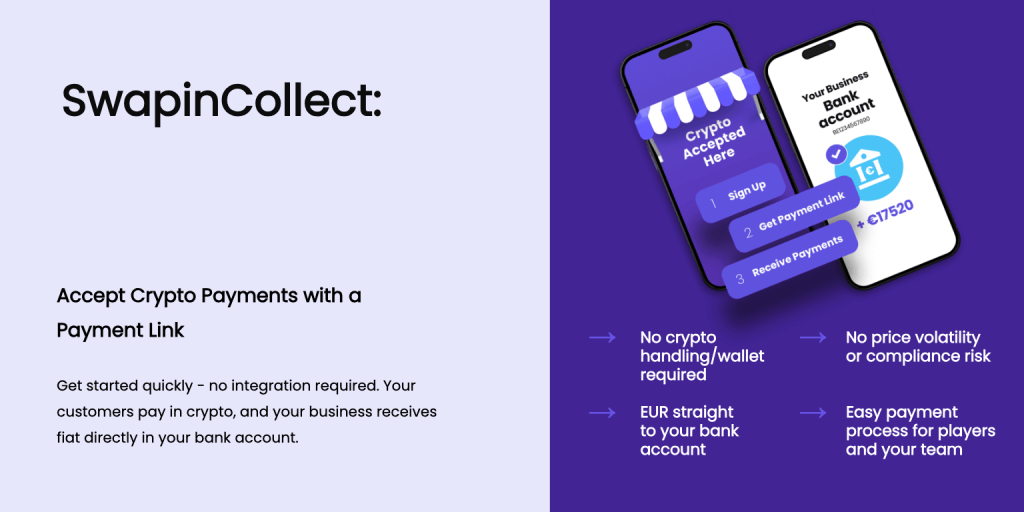
SwapinCollect payment link solution
How swapin drives business crypto adoption
Companies across industries are accepting crypto payments. Here are the three partner companies who made the decision to expand their payment services with Swapin.
DRIVAR: Making luxury car rentals accessible
Leading luxury car rental marketplace, DRIVAR started accepting crypto payments so their high-end clients have the flexibility to pay with cryptocurrencies. SwapinCollect’s instant conversion feature allowed them to reach an international client base while still receiving funds in euros.
“At DRIVAR, we see a great demand in the field of crypto and blockchain technology. Customers repeatedly ask us if we offer crypto payments. Swapin seems to be the perfect partner for strategic positioning in this direction. We are happy to work together.“
HBL: How accepting crypto made global expansion easy
As per the global lifestyle group, HBL, the luxury business domain is anchored in three principles: personalised services, global expertise, and seamless execution. So the natural next step was to offer their digitally-active clientele the option to pay with secure and globally accepted methods.
“Many of our clients, particularly those active in Web3, tech, and international business, are already managing wealth in digital assets. They want to pay in cryptocurrency to facilitate larger transactions in sectors where discretion and speed matter most. The challenge, until now, has been the lack of user-friendly, compliant, and secure solutions. That’s precisely why the Swapin partnership was so timely and strategic.”
Yachthub Group: All inclusive yachting matches with crypto payments
Yachthub Group’s motto is to provide hassle-free, professional services to their client base. In 2024, the growing crypto-forward customer base led them to pursue the option and look for potential providers. When reaching out to Swapin, the requirement was for a practical and easy to integrate solution that allows them to tap into the wider luxury yachting market.
“Crypto payments will allow us to tap into a market that is still pretty much untapped in Malta and also internationally, especially when it comes to boating. We are confident that we will gain some customers that we were not able to attract otherwise.”
Crypto users in 2025 are looking for ways to spend their assets. They want practical solutions and businesses that make the strategic decision to integrate crypto payments, stay ahead of competition.
Reach a global crypto-friendly audience with Swapin
The question isn’t whether your business should accept crypto, rather if it can afford to lose out on the potential client base that wants to make payments with crypto.
With Swapin you can:
→ expand to newer markets
→ benefit from faster and cheaper transactions
→ attract crypto-friendly customers
→ modernise business payment solutions
Start accepting crypto payments today – book a free demo call here.
How crypto processing platforms help businesses go global
Cryptocurrencies have moved beyond the confines of being an investment asset. It’s now a preferred payment method for high-value industries. Customers expect to pay using the methods they already hold, whether that is cards, digital wallets, or cryptocurrencies.
Crypto processing has emerged as part of this shift. Instead of building blockchain infrastructure internally, businesses can use a crypto processing platform to accept cryptocurrency payments while continuing to settle revenue in traditional currencies.
For merchants, this changes how cross-border payments are handled. Transactions can settle faster, international customers gain another way to pay, and businesses can expand payment acceptance without managing crypto directly.
This article covers the various industries that have partnered with crypto processing platforms in 2025.
A crypto processing platform allows businesses to accept cryptocurrency payments and settle them in either digital assets or fiat currency. Instead of building blockchain payment systems internally, companies can use a crypto processing platform that manages the technical and operational components of the transaction.
A crypto processing solution typically handles several functions:
accepting payments from customer crypto wallets
validating transactions on a blockchain network
converting cryptocurrencies into fiat or stablecoins
settling funds to the merchant’s bank account or wallet
For businesses, crypto processing simplifies the operational side of accepting digital assets. It removes the need to manage private keys, monitor price volatility, or integrate directly with blockchain networks.
It allows merchants to offer crypto as a payment option while maintaining familiar financial workflows. Funds can be received in fiat currencies such as EUR, USD, or GBP, while customers still pay using cryptocurrency.
Benefits of crypto processing for businesses
For companies operating across multiple markets, payment infrastructure affects how quickly revenue settles, how much is paid in transaction fees, and which customers can complete a purchase. Crypto processing introduces an additional payment rail that can address several operational challenges businesses face when expanding internationally.
Faster cross-border settlement
Traditional international payments often move through multiple intermediary banks and can take several days to settle. Crypto processing enables transactions to be validated on a blockchain network, allowing funds to settle significantly faster.
Lower payment friction for global customers
Customers who already hold digital assets can complete payments directly from their wallets. This reduces the need for currency conversions, card approvals, or international banking steps that can interrupt checkout.
Reduced infrastructure complexity
Without a processor, businesses would need to build wallet management systems, blockchain integrations, and compliance monitoring internally. Crypto processing platforms handle these technical components so companies can accept crypto without building their own infrastructure.
No exposure to cryptocurrency volatility
Many crypto processing providers offer instant conversion from cryptocurrency into fiat currencies. This allows businesses to receive the exact invoiced amount while avoiding price fluctuations associated with holding digital assets.
Expanded payment optionality at checkout
Adding cryptocurrency payments gives customers another way to pay, particularly in markets where access to traditional banking or card networks may be limited. For some customer segments, crypto can be a faster or more convenient payment method.
Together, these advantages explain why crypto processing is increasingly being evaluated by businesses that want to expand internationally while maintaining efficient and predictable payment operations.
Automotive industries
Whether it’s luxury cars or pre-owned car dealerships, crypto gateway solutions make purchases secure and settlements happen instantly, without relying on traditional banking systems.
Customers want diverse payment options that don’t incur exorbitant transaction and exchange fees. Crypto offers just that. Transparency, reduced fees, and frictionless settlements.
For dealerships, being able to accept crypto payments from clients opens up a larger client base. Not only can they now service international clients, they also don’t have to manage crypto payments directly. It’s a win-win for clients and dealerships.
According to the CEO, Silver Havamaa, the decision to accept crypto payments began after numerous client requests. Initially unsure about the volatility and technical requirements, they reached out to Swapin for a practical, quick, and easy solution.
Silver says, “It also feels excellent to say “Yes” to a customer instead of “No” – to tell them “pay however you want, whether it’s a bank transfer or Bitcoin.” This flexibility has strengthened our customer relationships.”
Read more on how one year of accepting crypto payments turned out for Mobile Keskus, here.
Luxury businesses
In the luxury industry, convenience, security, and exclusivity are non-negotiables. The industry thrives on building quality customer relations and the clients expect speed and flexibility at every step of the buying process.
In 2025, 60% of buyers are shopping online with direct crypto payments and 15% of the high-net-worth individuals prefer to pay with crypto for their luxury purchases. With the luxury market projected to cross $500 billion by 2029, businesses are keen to capture the market by staying ahead of competition.
Reaching an international clientele: Businesses are adding crypto solutions to their platforms, allowing them to not only reach new tech-friendly customers but also retain and nurture current clients who want more options.
Providing quick settlements: In an industry where speed is everything, traditional payments slow down businesses. Customers wait for days for banks to confirm and settle payments, incurring exorbitant transfer fees. Crypto payments cut out the middle men and settle payments near-instantly.
Receiving crypto payments without having to manage it: One major reason why some merchants stay away from crypto is because they assume they must hold the amount in crypto to do business.
But that’s not true. Payment links solution allows merchants to accept crypto payments and receive the full invoiced amount directly into their bank account, without having to manage it.
Hendrick, CEO of HBL, says, “Many of our clients, particularly those active in Web3, tech, and international business, are already managing wealth in digital assets. They want to pay in cryptocurrency to facilitate larger transactions in sectors where discretion and speed matter most.“
Clients want immediate and secure booking in the private aviation industry. Which means the faster the merchant responds and fulfills the booking, the more likely they are to retain their clients. It also opens up newer avenues for clients, providing them with flexibility and ease.
Finer Aviation diversified their payment systems and now can have three bookings in a day with three different methods. One wire in USD, one GBP faster payment, and another client request to pay in Bitcoin. Nathan says, “Our customer base is global, and we have to support efficient clearing times wherever they are in the world.”
Cryptocurrencies global access, low fees, and 24/7 transaction turns out to be a helpful use case for the aviation sector.
When bank transfers can take up to 72 hours, crypto processing platforms offer instant and secure payments. Hugo, Sales Manager at Altinium, says “With a new generation of clients already investing heavily in crypto, offering this option isn’t just convenient, it’s the future of seamless high-end travel.”
Learn more: Access a global private aviation market with a crypto gateway platform.
Another industry that is seeing the rise in crypto processing, sports and entertainment businesses have the capacity to reach a tech-friendly audience who now want to spend their crypto assets on everyday expenses.
For Yolo Squash, the idea was to experiment with crypto payments and understand the market demand. So when the integration picked up speed without a marketing campaign, founder Andri was certain they’re on the right track.
Andri says, “Our payment option has been active for about 1.5 months, and since there hasn’t been any direct promotion or advertising campaign yet, the volume of payments is still in the initial stage. However, the payment option that has been implemented so far has come as a positive surprise to clients, and the reception has been very good.”
And for brands that are all about innovation, accepting crypto was the logical next step.
When Marcis launched Efoilriga, it was the first of its kind in Latvia and soon picked up momentum amongst watersports lovers. Being a crypto enthusiast himself, Marcis decided to offer crypto payments so he can reach an international clientele from his home base, Latvia.
He says, “Accepting crypto aligns our brand with modern technology, caters to this forward-thinking audience, and provides an additional layer of convenience. The key for us was simplicity and risk elimination. Swapin instantly converts any crypto payment into Euros and deposits it directly into our company bank account. Thus removing complexity and volatility risk associated with holding crypto.”
How businesses can implement crypto processing
Businesses that want to accept cryptocurrency payments typically have two main implementation paths. The right approach depends on technical resources, compliance capabilities, and how quickly the company wants to launch.
Some companies choose to build their own crypto processing infrastructure, giving them full control over payment flows, custody models, and blockchain integrations.
However, building internally requires significant technical and operational investment.
The more common approach is integrating with a crypto processing platform that already provides the required infrastructure. In this model, businesses can accept cryptocurrency payments while the provider manages the underlying blockchain interactions.
A crypto processing provider typically handles:
wallet payment acceptance
transaction validation on blockchain networks
optional conversion from crypto into fiat or stablecoins
settlement to a merchant’s bank account or wallet
This allows businesses to add cryptocurrency payments to their checkout or invoicing systems without building blockchain infrastructure internally. Integration can usually be completed through APIs, payment links, or hosted checkout solutions depending on the provider.
Choosing a crypto processing provider
Not all crypto processing platforms operate the same way. For businesses evaluating providers, the decision should focus on how well the infrastructure integrates with existing payment operations, compliance requirements, and settlement needs.
Several factors are typically considered when selecting a crypto processing provider.
Settlement options
Some platforms require merchants to hold cryptocurrency after receiving payments. Others offer automatic conversion into fiat currencies. Businesses that want to avoid volatility often choose providers that support instant conversion and bank settlement.
Supported cryptocurrencies and stablecoins
Providers differ in the assets they support. Many businesses prioritize stablecoins because they reduce price fluctuations during transactions and are widely used for payments.
Integration flexibility
Crypto processing should integrate easily with existing checkout systems, invoicing workflows, or payment pages. Providers may offer APIs, hosted checkout pages, payment links, or plugins for ecommerce platforms.
Compliance and regulatory coverage
Businesses operating internationally must consider regulatory requirements around digital asset transactions. A crypto processing provider should support transaction monitoring, AML controls, and compliance with relevant licensing frameworks.
Geographic coverage and banking relationships
Settlement capabilities vary depending on the provider’s banking infrastructure. Businesses should evaluate whether the platform can settle funds into the currencies and regions where they operate.
Operational reliability and security
Crypto transactions are irreversible once confirmed on-chain. A provider should demonstrate strong security practices, infrastructure stability, and transparent transaction monitoring to reduce operational risk.
Crypto processing made easier with Swapin
SwapinCollect is a payment links solution that allows merchants to settle payments in real-time, with no volatility risk. Businesses can now accept crypto payments from clients and receive direct EUR payouts to their bank account – no wallets, no complex integration, no hidden fees.
Curious about how your business can access a global client base? Chat with our team or book a demo here to explore the possibilities.
How stablecoins simplify cross border payments for businesses in 2025
Stablecoins are a practical solution for businesses facing slow, costly, and complex payment systems. Pegged to fiat currencies such as USD and EUR, these cryptocurrencies hold steady value, offering businesses a simpler and cheaper cross border payments solution.
In 2025, the total adjusted transaction volume reached USD$6.7 trillion alone. Highlighting an interesting shift in business and consumer spending behaviour.
In this guide, we explain stablecoins, what makes them a practical alternative to traditional payment solutions, and how businesses can incorporate them into their payment strategies.
Unlike other cryptocurrencies, stablecoins aren’t subject to the same level of volatility. It’s designed to hold steady value. Businesses can avoid fluctuating price loss and settle payments without any intermediaries and transaction fees, particularly in cross border payments.
Reserve-backed stablecoins are backed by real assets such as USD, EUR, or gold in a bank. Essentially, a $1 stablecoin is to be backed by $1 in these assets to maintain the steady value.
It creates an arbitrage loop, keeping the stablecoin close to its peg. The model depends on liquid reserves and transparent operations so that when it’s well maintained, the peg is stable.
On the other hand, algorithmic stablecoins use software to maintain value. Let’s say the stablecoin drops below $1, the system reduces supply and allows users to trade stablecoins for a redeemable bond-like token. If it goes above $1, the system mints additional coins to bring the value back down, creating a balanced supply-demand without a central custodian.
Stablecoin payments allow businesses to reach a global client base without any third-party intermediaries, save on exorbitant transaction fees, and settle invoices within minutes.
Stablecoins vs traditional payment methods: What’s better for cross border payments
Compared to stablecoin payments, traditional methods such as wire transfers, SWIFT, cards, and digital payments involve multiple intermediaries, high transaction and conversion fees, and slow processing time.
So while bank transfers can take 3-5 days and charge up to 12% transfer fees for international payments, stablecoin payments range anywhere between 1-2% and are settled in real time.
Reconciliation takes longer in traditional payments due to multiple banking partners and networks and often leads to errors. Stablecoin transactions are recorded on a blockchain network, reducing chargebacks and providing real-time transparency.
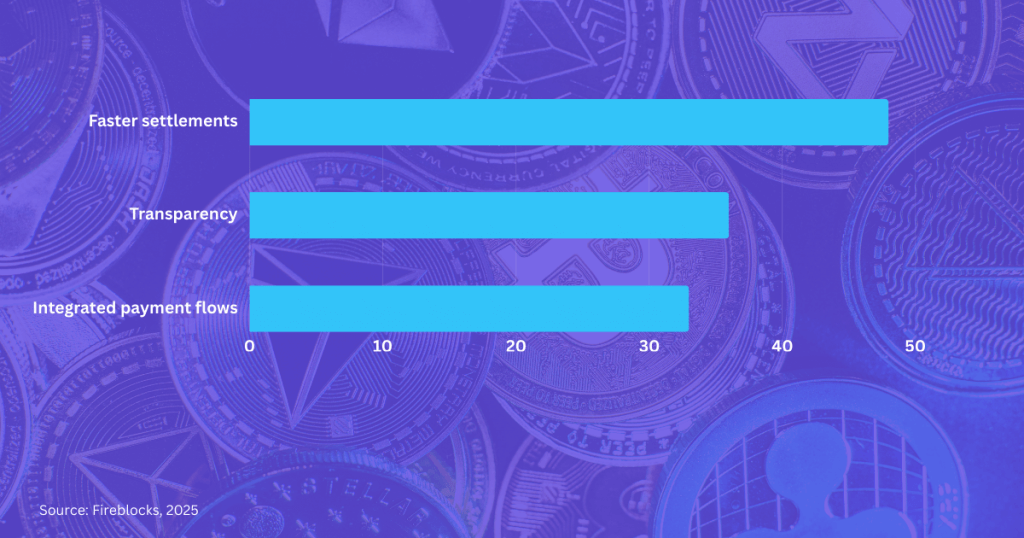
In a study conducted by Fireblocks, 48% of businesses cite faster settlements as the major stablecoin benefit. 36% cited transparency as the next major reason, and 33% voting for integrated payment flows and better liquidity management.
How businesses use stablecoins for cross border payments
What used to be a trading tool is now one of the fastest growing payment infrastructure thanks to zero intermediaries and instant settlements. And so far, stablecoins have been incorporated for the following use cases:
→ Cross-border payments for international businesses and suppliers.
→ Paying contractors and freelancers and settling invoices in minutes.
→ Automated and recurring payments services to reduce administrative overhead.
→ Payroll solutions to employees in regions with limited banking infrastructure.
→ Treasury management to maintain liquidity without exposure to volatile crypto markets.
→ Integrating with existing ERP systems for efficient reconciliation and reporting.
How to accept payments in stablecoins
Businesses can accept stablecoin payment with one simple solution: crypto payment links.
SwapinCollect is a payment link solution that allows businesses to receive payments in crypto from their users in two simple steps:
Step 1: The merchant creates a prefilled invoice that includes the payment link for a quick and easy transaction.
Step 2: After clicking on the link provided, the customer is redirected to the payment gateway to select their preferred payment method and initiate the transaction.
Step 3: The payment gateway verifies the payment details, checks validity and sufficient funds before authorising it.
Step 4: Once verified, the funds are deducted from the users account and a notification is sent confirming the payment.
Step 5: Once funds are transferred to the business’ bank account, the settlement can take anywhere between a few minutes to a few days, depending on the payment method.
Swapin offers a flexible and user-friendly solution for businesses looking to accept crypto payments through website or QR code.
→ Businesses don’t need to handle crypto or hold a wallet. Swapin provides an end-to-end solution. Simply receive funds in your bank account and focus on scaling business operations.
→ No hidden fees. Your client pays the transaction fees, meaning there are no extra costs to your business. You’ll receive the exact invoiced amount every time.
→ Licensed and secure payment solution. Swapin is fully regulated, licensed, and audited by Grant Thornton, ensuring that your transactions are handled with the highest standards of security and compliance.
→ No manual reconciliation for your accounting team. All payments are converted automatically into fiat and processed with the payment description.
→ Expand to new markets and tap into a growing global customer base of crypto owners, offering your products to high-net-worth individuals.
→ No need for any technical expertise to get started. Simply sign up and start accepting crypto payments from your clients in one business day.
→ Accept payments from customers across borders, offering cost-effective and fast international transactions.
Learn more about how Swapin can help scale your business or get started today.
Crypto merchant payments: Top 3 concerns in 2026
Crypto adoption has come a long way. Not only do more people own cryptocurrencies today, but 80% of crypto owners want to pay for everyday purchases with crypto.
Businesses now have the right window to innovate and address the evolving client demands for newer payment options. While it can be a big decision for most merchants, in this blog we breakdown the top concerns businesses have when it comes to crypto payments and how payment gateway providers such as Swapin can help.
One of the biggest concerns merchants have accepting crypto payments is the idea of price volatility. Thinking the crypto market is too unstable and sudden price swings can directly affect their business.
But unless you hold onto cryptocurrencies purely as an asset, volatility is controlled for stable business payments. This is because merchants don’t have to hold or invest in crypto. They simply accept the payment and immediately receive euros into their bank account.
A crypto payment gateway (or payment processor) takes away the volatility risk. Here’s how:
Step 1: Customer makes a payment
The customer decides to pay with their preferred cryptocurrency with either a crypto payment link or an integrated checkout option.
Step 2: Payment processor secures transaction
The crypto payment processor receives the payment requests and generates a unique payment address. The customer then sends the funds to the unique address after which the transaction is encrypted and recorded on the network.
Step 3: Payment confirmation
The network then verifies, confirms, and monitors the payment. Depending on the network, this process can take anywhere between a few seconds to minutes.
Step 4: Crypto to fiat conversion
Once the payment is confirmed, the gateway then converts the funds to fiat and directly deposits it to the business’ bank account. This way the merchant receives the exact invoiced amount without needing to manage crypto wallets or worrying about volatility.
So in the end, customers pay with crypto and merchants receive euros in their bank account with practically zero volatility.
This is extremely important for businesses with an international client base who prefer to pay with crypto for quick settlements. Private jet company Altinium and Finer Aviation partnered with Swapin. To cater their international clientele better and meet their evolving expectations, both companies decided to offer crypto payment options.
Hugo from Altinium says, “Our clients pay exactly what they agreed for — no hidden markups, no kickbacks disguised as fees. They enter the amount, see Swapin’s transaction fee clearly, and that’s it. Simple, transparent, and aligned with our ethos.”
Accepting crypto is complicated
Many businesses shy away from accepting crypto payments because they fear the technical expertise required to build a functional payment gateway.
That would be true if the business wants to take on the initiative in-house and hire dedicated tech and compliance teams. But crypto merchant payments have come a long way and businesses no longer need complex integrations. Today, a wide range of industries, including e-commerce, luxury, and travel are benefiting from these solutions, thanks to their versatility and customizability for diverse business needs.
Working with a crypto payment processor means businesses don’t need to build the solution from scratch. A simple API integration is all that’s needed to get started. And for merchants who are just getting started with crypto because they want to attract international, crypto-friendly clients, SwapinCollect, a payment link solution, requires absolutely zero integration.
Crypto payment gateways also support stablecoin payments, which offer significant advantages for global transactions, such as instant settlement and simplified cross-border payments without traditional banking dependencies. Merchants benefit from lower transaction fees when using stablecoins and other cryptocurrencies, improving profit margins compared to traditional payment methods.
Here’s how businesses can accept crypto payments in just one day with the payment link solution:
Step 1: Sign up on the platform and complete onboarding
Step 2: Set up a crypto payment link
Step 3: Share the payment link with clients and start accepting crypto
Step 4: Receive the exact invoiced amount in euros directly in your bank account
When luxury boutique yacht company, Villa Yachting, partnered with Swapin, they had one request — keep it simple. While they had growing demands for crypto payments, they also prioritised building strong and close client connections. So they wanted a partner that could take care of the technical requirements but also understand the high-expectations of their client base.
Michela says, “We wanted a partner who understood both the technical side of crypto and the high standards of luxury service. The biggest impact has been simplicity. Our clients can pay quickly and securely, and we receive the equivalent in euros — with no disruption on our side.”
Not enough customers want to make crypto payments
Did you know 60% of buyers make direct crypto payments when making online purchases? In 2025, 43% of e-commerce merchants have now started to accept crypto to meet the growing demands. And globally, 7.2% people own cryptocurrencies. These aren’t just random statistics, regulatory developments are going to lead crypto payment adoption by 85% through 2026.
So it’s no longer whether you should accept crypto or not but rather, can you afford to miss out on a global crypto-friendly audience?
This is especially important for businesses with an international client base and want to target international markets. Relying on traditional payment rails can slow down business due to multiple intermediaries and transfer costs. Crypto payment rails take away the intermediaries, thus bringing down the conversion costs.
Now a client from South America can easily pay businesses based in the EU without worrying about conversion rate fluctuations or delays.
Managing crypto merchant payments: How businesses actually get paid
When a customer completes a cryptocurrency payment, the transaction is processed and verified on the blockchain, ensuring transparency and security. The crypto payment gateway then takes over, handling the conversion and transfer of funds. Merchants receive the payment directly to their bank account as fiat currencies such as EUR or USD.
This means:
→ you don’t have to worry about manually exchanging your crypto assets or tracking market prices
→ the payment gateway automatically converts the received crypto into your preferred currency, protecting your business from the price swings often associated with crypto transactions
→ payouts can also be made in supported cryptocurrencies, including Bitcoin and stablecoins, further reducing volatility risk
Crypto payment gateways enable fast, low-cost transactions compared to traditional payment methods, helping you save on transaction fees and improve your bottom line. With easy integration, whether through APIs or payment links, you can provide multiple payment options to your customers without disrupting your existing workflow.
The zero-integration solution for crypto merchant payments
No integration. No volatility risk. No crypto management. Simply create a payment link, share it with your clients, and start accepting crypto from day one. Learn more about how you can access a global market with an all inclusive crypto payment links solution or get started today.
How crypto payment providers simplify luxury business needs
When we think of luxury, we think exclusivity, prestige, and innovation. But apart from that, luxury shoppers need payment solutions that are quick, secure, and require minimal effort. When making high-ticket purchases, speed and security are non-negotiables. And when clients make multi-currency international purchases online, it can add up the exchange fees and processing time significantly.
So it makes perfect sense why consumers are shifting to crypto payments. Until recently, only a handful of luxury brands such as Louis Vuitton, Hublot, and Tag Heuer were accepting crypto payments. But now with the notable rise in crypto users across the globe, businesses can no longer ignore the market demands.
As per 2025 statistics, 60% of buyers make direct crypto payments when making online purchases with 15% of high-net worth individuals using crypto for luxury purchases. To meet the growing demands, 43% of e-commerce merchants have now started to accept crypto. Gucci now accepts 12 cryptocurrencies across the US, appealing to their growing Gen Z client base.
The luxury market is projected to surpass $500 billion by 2029 and see a rise in crypto transactions beyond investments. Thanks to crypto payment providers, modern crypto owners now want to spend their crypto assets on high-value purchases — driving mainstream adoption.
Reach a wider client base with crypto payment providers
As of 2025, 7.2% of the total population own cryptocurrencies. Regulatory developments and tech advancements are leading crypto payment adoption by 85% through 2026.
Businesses across the globe now have a wider client base to reach if they start to receive crypto payments. Demographically, millennials make up for 40% of total crypto users while 15% of Gen X hold at least one type of cryptocurrency.
But more than the age group, it’s the idea that people want practical use cases for their crypto assets. The need for efficiency and innovation is driving crypto payment adoption, and businesses have the right window to tap into a global, crypto-friendly client base.
Private jet company Finer Aviation diversified their payment ecosystem to cryptocurrencies to serve international clienteles.
Nathan says, “I can have three bookings in a day. One wire in USD, one GBP faster payment, and another client request to pay in Bitcoin. Our customer base is global, and we have to support efficient clearing times wherever they are in the world.”
Offering crypto payments allows businesses to bypass borders and reach buyers that otherwise would be complex due to international banking rules and regulations.
How crypto financial services simplifies payments
One non-negotiable amongst crypto owners is simplicity and speed. When international clients have to wait for days for banks to confirm payments, this can really slow down business, leading to dissatisfied consumer experience.
In the private aviation and charter industry, clients want immediate and secure bookings. So when Altinium partnered with Swapin, they wanted a quick and easy payment solution for their international clientele.
Hugo says, “private aviation is about efficiency and time. Bank transfers can take up to 72 hours, while crypto offers instant, secure payments — which means flights can take off faster. With a new generation of clients already investing heavily in crypto, offering this option isn’t just convenient, it’s the future of seamless high-end travel.”
Compared to traditional banks where payments take anywhere from 3-5 days to settle, crypto payments are near instant. Eliminating intermediaries such as banking partners makes the process much faster and cheaper.
The benefit isn’t just that crypto owners can make near-instant payments from anywhere around the globe. Merchants can also accept various cryptocurrencies and get paid in euros, directly into their bank account.
Boutique yachting company Villa Yachting prioritises flexibility and availability for their luxury clientele. And for that, they wanted a payments partner that can take care of the technical aspects and crypto management.
Michela says, “Our clients can pay quickly and securely, and we receive the equivalent in euros — with no disruption on our side. It’s streamlined and professional, and it reinforces our positioning as a company that’s both boutique and forward-thinking.”
When our partners sign up for SwapinCollect (or the crypto payment links solution), they can start accepting crypto payments from day one. So there’s no need to go through complex integrations or manage crypto payments. Clients pay with their preferred cryptocurrencies and merchants get the exact amount directly into their bank account.
No reconciliation hassle for the accounting team and no conversion fees for merchants to worry about.
Offer flexible payment options to clients
Businesses new to crypto payments assume they need a complete system overhaul and build an integration from scratch. But partnering with crypto payment providers makes the process easier. SwapinCollect’s zero integration solution allows merchants to start accepting crypto from day one.
Essentially, the business is adding another payment method to their system so clients can choose to pay with their preferred methods. Especially for the international client base who benefit from saving up to 80% in transaction fees compared to bank payments.
For luxury jewellery brand Henningson Black Level, the clientele happened to be crypto enthusiasts as well. So deciding to receive crypto payments allowed the company to expand their client base easily.
Hendrick says, “Many of our clients, particularly those active in Web3, tech, and international business, are already managing wealth in digital assets. They want to pay in cryptocurrency to facilitate larger transactions in sectors where discretion and speed matter most. The challenge, until now, has been the lack of user-friendly, compliant, and secure solutions.”
Offering clients the option to pay with crypto allows businesses to position themselves as more accessible and responsive to the growing client needs.
Crypto financial services built for luxury payments
Ultimately, crypto payments in the luxury business is all about simplifying the end user’s experience. The buyers want fast, borderless, and secure solutions. Partnering with crypto payment providers makes it easy.
Interested in accepting crypto payments for your luxury business? Reach out to us and learn more about how our solution fits your business needs.
Altinium x Swapin: Crypto Payments Take Flight in Private Aviation
With 100 years of experience, French private aviation company Altinium has redefined what it means to run a business without compromising on trust, legacy, and innovation.
In this exclusive interview, Hugo Gaden, sales director at Altinium talks about managing diverse client needs in a competitive and high-ticket industry. We cover how Altinium prioritises personalised client management at all four markets – France, Switzerland, Latvia, and Malta. And how crypto payments has enabled them to cater to an international client base looking for quick and secure payment solutions.
Q: Altinium has roots going back to 1924 with Charles Franco, great-grandfather of the company founders, a test pilot and aviation trainer. Tell us more about how his passion shaped the company’s identity today.
Hugo: The company has always been shaped around the passion for aviation, and the importance of expertise, with the goal of “making aviation better”. From charter clients to aircraft owners, our dedication and experience helped us build trust with them over the years.
Q: When clients choose Altinium, they’re not just choosing an aircraft, they’re joining a story almost 100 years in the making. How do you communicate that sense of legacy?
Hugo: When clients choose Altinium, they’re choosing people first. We genuinely care about them, and we put all our energy into finding the best solutions for their needs. With some clients, the relationship goes far beyond aviation, it becomes almost like family.
Q: Trust and transparency are recurring themes in your work. How do you translate those values into a tangible client experience?
Hugo: We see ourselves as true partners, for our clients’ business and even their family life. Trust and transparency are the foundation: they know they can rely on us anytime, and we value their seriousness in return. It’s a win-win. The more we help them grow, the more they fly, and the more satisfied they become.
Creating a market presence and differentiation
Q: Private aviation is a competitive market. What makes Altinium’s approach to aircraft management, sales, and charter services stand apart?
Hugo: What sets us apart is simple: transparency and efficiency. Most of our new clients come from referrals, which says it all. While some companies chase volume, we focus on a carefully selected portfolio, so we can dedicate ourselves fully, react fast, and always deliver the best solutions. We value people, they value us — and together, we make it happen.
Q: Safety and compliance are central to your brand. How do you balance strict adherence to EASA and FAA rules with delivering a premium, seamless client experience?
Hugo: I always tell my clients: “I would never offer you an aircraft I wouldn’t fly on myself.” That says it all. We carefully select our operators, personally test their service, and regularly visit their offices and maintenance centers. This way, we guarantee both strict compliance and a seamless, premium experience.
Q: From private jets to helicopters, Altinium covers charter, sales, acquisitions, management, maintenance, and even concierge services. Which of these areas is driving the most growth today?
Hugo: We’ve seen strong growth in concierge services, especially from long-term clients. It usually starts when their yacht broker or chauffeur company lets them down. They call us to fix it, and we deliver. From there, they trust us with entire trips or holidays, knowing they’ll get the same level of satisfaction they already experience with our jets.
Building customer success through personalised management
Q: For a first-time aircraft buyer, what key advice do you give to help them avoid costly mistakes?
Hugo: My main advice is: don’t rush. Take the time to define your real usage, and trust us to guide you on the right aircraft type and registration. Overestimating or underestimating your needs can lead to very costly mistakes. And don’t copy your friends’ jet. Every client is different, and our job is to find the one that truly fits you.
Q: How do you help owners decide between private versus commercial management of their aircraft?
Hugo: It all comes down to usage. If an owner flies frequently, on short notice, or with very specific needs, private management often makes more sense. If not, commercial management can be more efficient. We always present both options, with clear pros and cons, so the owner can make the best decision for their lifestyle and objectives.
Q: Beyond aircraft, Altinium offers concierge services such as villas, yachts, and drivers. How important is it to create a full lifestyle experience?
Hugo: Our goal is simple: make our clients’ lives effortless. Flying private is about saving time, so we extend that efficiency to everything around the flight — villas, yachts, drivers, you name it. Through trusted partners, we ensure a seamless lifestyle experience, tailored to what our clients truly value.
The strategic decision to accept crypto payments
Q: Private aviation has always been about exclusivity and innovation. How do you envision crypto payments shaping the future of high-end travel?
Hugo: Private aviation is about efficiency and time. Bank transfers can take up to 72 hours, while crypto offers instant, secure payments — which means flights can take off faster. With a new generation of clients already investing heavily in crypto, offering this option isn’t just convenient, it’s the future of seamless high-end travel.
Q: What was the key deciding factor for partnering with Swapin?
Hugo: We wanted a safe, quick, and seamless way for our clients to pay with crypto. Swapin stood out for its security and user experience. We tested it with a few clients, they loved it, so we decided to fully adopt it.
Q: Altinium’s brand ethos emphasizes transparency and trust in transactions. How do you see Swapin’s crypto payments solution as a natural extension of what the brand stands for?
Hugo: What we value with Swapin is transparency. Our clients pay exactly what they agreed for — no hidden markups, no kickbacks disguised as fees. They enter the amount, see Swapin’s transaction fee clearly, and that’s it. Simple, transparent, and aligned with our ethos.
Q: Aircraft service involves international clients and cross-border payments. How does crypto simplify and accelerate these processes compared to traditional banking systems?
Hugo: With crypto, geography no longer matters. No matter where the client is based, they can pay instantly, and we receive the funds directly in the currency we choose. Compared to traditional bank transfers — which can take days and get stuck in cross-border regulations — crypto is faster, simpler, and perfectly suited to the pace of private aviation.
Q: Altinium has roots in France, Switzerland, Latvia, and Malta. What has international expansion taught you about serving clients with very different aviation needs?
Hugo: International expansion taught us one key thing: flexibility. Every market has different aviation habits, but our network and expertise allow us to adapt quickly and serve clients almost anywhere in the world. Wherever they are, they know they can rely on the same Altinium standard.
Q: Technology is shaping aviation. Where do you see the biggest opportunities for innovation in private aircraft management and sales?
Hugo: AI can make private aviation more efficient, but it will never replace human relationships and trust. At the end of the day, our clients don’t just value speed — they value our ability to solve problems when they arise. We’ve seen platforms promising “instant booking” for private jets, which simply doesn’t reflect reality. Many disappointed clients came to us afterwards, realizing that no app can replace the efficiency and reliability of an experienced team.
Q: Based on your experience, what is your message and advice to companies unsure about crypto payments?
Hugo: My advice is simple: with Swapin, you don’t need to worry about crypto at all. You receive EUR, GBP, or USD directly in your account, just like a bank transfer but faster. There’s no handling of crypto, no exposure to market volatility. For the company, it’s as easy and safe as a credit card payment, only more efficient.
A word from Swapin CEO & Founder
Evald-Hannes Kree, CEO of Swapin, shared his thoughts on the partnership with Altinium.
The more forward thinking businesses are, the better they are able to serve clients and scale. Altinium proved that when you’re attentive to your clients’ needs, market expansion and growth becomes easier. And you can tell they are truly client-focused because not only do they offer personalised care and management, they’re also prioritising convenience and security for consumers in the best way possible.
This is a nod to businesses waiting for the green signal to accept crypto payments. The demand is building and companies that make quick decisions avoid losing out on crypto-friendly customers. Think of it as another payment solution that you can offer without needing to manage the manual conversions. So you can serve crypto paying clients and receive funds in euros — with zero integration.
As Hugo correctly mentioned, “With crypto, geography no longer matters. No matter where the client is based, they can pay instantly, and we receive the funds directly in the currency we choose”.
The zero-integration crypto payments link solution
Swapin’s crypto payment links solution allows businesses to settle payments in real-time, establishing trust and convenience for a luxurious experience. Businesses can now accept crypto payments from clients and receive direct EUR payouts to their bank account – no wallets, no complex integration, no volatility.
Curious about how your private aviation business can access a global client base through a crypto gateway provider?
Chat with our team or book a demo here to explore the possibilities.
Boutique meets crypto payments: Villa Yachting partners with Swapin
Villa Yachting is a young family-owned boutique company specialised in yacht sales & purchase and luxury yacht charter. With over 20 years of maritime and yachting experience, @Michela Villa launched the boutique luxury company @Villa Yachting in 2021 in Genova, Italy.
In this exclusive interview, Michela talks how their conscious choice to stay boutique has helped attend to clients in a personalised and flexible manner. And how their decision to accept crypto payments signals led to an increased client satisfaction.
Q: With over 20 years of experience in the yachting industry, what inspired Villa Yachting?
Michela: Villa Yachting was born from a deep-rooted passion for the sea and a strong sense of heritage. We grew up in a maritime family — our father was an admiral in the Navy — and the ocean was always part of our story. Over the years, this passion evolved into a desire to offer something more personal in the yachting world: a company where relationships come first, and where excellence is not about size, but about care, trust, and attention to detail.
Q: Villa Yachting is family-owned and boutique by design. Why was it important for you to take this approach rather than scaling into a larger corporate-style operation?
Michela: We made a conscious choice to stay boutique because we believe luxury is about connection, not volume. A smaller structure allows us to remain flexible, available, and fully present for each client. It means we can act fast, adapt to specific needs, and build long-term relationships based on trust — not transactions. Our clients know that when they call, they speak to someone who knows them, not a call center.
Q: What makes Villa Yachting’s “tailored first-class service” different from the rest in practice?
Michela: For us, tailored service goes far beyond matching a yacht to a request. It means understanding what truly matters to each client — their lifestyle, ambitions, and personal preferences — and shaping the entire experience around that. Whether it’s a sale, a charter, or a management project, we’re hands-on at every stage. Our team anticipates needs before they arise, and we pride ourselves on the discretion and warmth that come with working as a close-knit crew, not a machine.
Personalised client management at every step of the process
Q: How has Villa Yachting adapted to shifts in client expectations over the years?
Michela: Client expectations have evolved toward more immediacy, flexibility, and transparency. We’ve embraced these changes by staying agile — adopting new tools, streamlining our communication, and expanding our network of trusted partners. The way people experience luxury has also changed. Today, it’s about feeling understood and effortlessly supported. That’s where we’ve always found our strength.
Q: How do you simplify yachting and charter for your clients so they feel taken care of throughout the journey?
Michela: We act as a single point of contact from start to finish — whether for a purchase, a charter, or ongoing yacht management. Our goal is to remove complexity, not add layers. From coordinating technical aspects to ensuring client preferences are respected at every step, we manage operations with quiet precision so our clients can focus on enjoying their yachting experience.
Q: How do you manage client needs early on and how do you tailor the approach for a personalised experience?
Michela: It starts with listening. We take the time to truly understand who our client is — not just what they need, but how they prefer to communicate, make decisions, and experience yachting. Whether they’re seasoned owners or newcomers, we adapt our approach to their rhythm and mindset. From the first exchange, the relationship is already being shaped around them.
Q: Villa Yachting is built on trust, honesty, and dedication. How do you reinforce those values to go beyond transactional exchanges?
Michela: We treat every client like a long-term partner, not a one-time deal. That means full transparency, honest advice — even when it means challenging the brief — and consistent support throughout. We don’t disappear after the contract is signed. Whether it’s a buyer, an owner or a charter guest, we’re there every step of the way, because trust is built over time — and that’s the kind of relationship we’re here to build.
Meeting evolving client needs with crypto payments
Q: How have your clients responded to the crypto payment options? Have you noticed an upward trend in enquiries or bookings?
Michela: We’ve had very positive feedback — especially from international clients, who appreciate the speed, simplicity, and flexibility that crypto offers. While it’s not yet the dominant method, it’s definitely gaining momentum, and offering it reflects our commitment to evolving with our clients’ habits and expectations.
Q: Why did you choose to partner with Swapin? What was the key deciding factor?
Michela: We chose Swapin because the solution was clear, secure, and aligned with our way of working: reliable and client-friendly. We wanted a partner who understood both the technical side of crypto and the high standards of luxury service. Swapin made the integration seamless — which is exactly what we needed.
Q: How has Swapin made accepting crypto payments easier for Villa Yachting? What has been the biggest impact, business or otherwise, since the collaboration?
Michela: The biggest impact has been simplicity. Our clients can pay quickly and securely, and we receive the equivalent in euros — with no disruption on our side. It’s streamlined and professional, and it reinforces our positioning as a company that’s both boutique and forward-thinking.
Crypto payments: how modern clients spend their assets
Q: What stands out among crypto-using clients compared to those who prefer traditional payments?
Michela: Crypto-using clients tend to be highly connected, independent, and efficiency-driven. They value discretion, speed, and modern solutions. For them, the ability to pay in crypto isn’t just practical — it signals that they’re dealing with a company that understands their pace and mindset. It also shows that we’re open to evolving with their preferences.
Q: Are crypto payments more common with a younger, tech-savvy demographic, or are established yacht owners also adopting it?
Michela: We’ve seen interest from both. Younger, tech-forward clients are naturally more comfortable with crypto, but some of our established yacht owners are also curious — especially those with international businesses or a keen eye on investment trends. In the end, it’s less about age and more about mindset: those who see the value in flexibility and innovation are open to it.
Q: Has crypto opened the door to new clients discovering yachting? How has it created an added convenience for your current client base?
Michela: Yes, absolutely. It’s positioned us as more accessible to a new segment of clients — particularly entrepreneurs and digital natives who value optionality. For existing clients, it’s one more layer of convenience: it reduces friction, speeds up transactions, and fits into a more modern, global way of doing things.
Q: How does offering crypto align with your long-term vision for Villa Yachting’s brand identity?
Michela: It aligns perfectly. We’ve always positioned ourselves as a boutique, client-first company — one that listens, adapts, and evolves. Offering crypto is a natural extension of that vision. It’s not about following trends, it’s about staying relevant and responsive to the real needs of our clients, today and tomorrow.
Future plans for Villa Yachting
Q: Beyond payments, what are the possible areas where the yachting sector can innovate?
Michela: There’s room to innovate in how we manage data, streamline logistics, and personalise the client experience even further. From digital onboarding and smart maintenance tracking to integrated apps for onboard preferences — the future of yachting is about making complexity feel invisible, while maintaining a deeply human touch.
Q: Beyond convenience, how do you think crypto payments have shifted client habits and expectations with luxury?
Michela: Luxury used to be about excess. Now it’s about ease, relevance, and access — delivered seamlessly. Crypto plays into that shift: it removes traditional constraints and empowers clients to move at their own pace. In a way, it reinforces the idea that luxury should fit into their life, not the other way around.
Q: What advice would you give to other luxury businesses especially in terms of payment and tech integration?
Michela: Start with your clients — not the technology. Don’t integrate a solution because it’s new or popular; do it because it genuinely adds value to your client’s experience. And keep it simple. The best tech is the one that disappears in the background while making things smoother, faster, and more elegant.
A word from Swapin CEO & Founder
Evald-Hannes Kree, CEO of Swapin, shared his thoughts on the partnership with Villa Yachting.
Villa Yachting responded to early client requests without waiting for too long. And when you’re attentive to your clients’ needs, growth is easier. Villa Yachting has decisively remained boutique to build long-term connections with their clients. Prioritising quality over quantity allows them to quickly adapt to evolving client demands better.
Swapin makes the process easier. Our partners don’t have to overhaul their systems to incorporate crypto payments. With SwapinCollect, businesses can start accepting crypto payments in one day with zero integration. So to the businesses that are contemplating, I would like to point out that the demand is only increasing and a quick decision can help avoid losing out on crypto-friendly clients.
Start accepting crypto payments from day 1
Swapin’s crypto payment gateway solution allows businesses to settle payments in real-time, establishing trust and convenience for a luxurious experience. Businesses accept crypto payments from clients and receive EUR directly into their bank account – no wallets, no complex integration, no volatility.
Grow your business and access a global client base looking to pay with crypto.
Chat with our team or book a demo here to explore the possibilities.