
Stablecoins go mainstream: why merchants are opting for crypto payment in 2026
As we gear up for 2026, it’s time to reflect on how the crypto payments industry fared this year.
And to get a clearer picture on the industry shifts that are playing out, we sat down with Ivar Jaanus, Swapin’s Head of Business Development. Working directly with high-value merchants, understands user behaviour, adoption dynamics, and industry trends on the ground level.
The three insights that set the tone for 2025, are:
1. Stablecoins have become the default cryptocurrency options as merchants proactively offer it to clients alongside traditional payment methods.
2. Volatility, compliance, and operational concerns are no longer deal-breakers. Merchants are increasingly partnering with trusted providers that manage regulatory and operational requirements.
3. Clients now want to pay with crypto and that’s a major factor driving merchant adoption. Signalling that genuine demand will inevitably win.
Shifting merchant behaviour
Q: What are the top 3 changes you noted in client behaviours in 2025?
Ivar: High-value clients are no longer exploring crypto payments, they’re directly requesting for stablecoin payment options. And, speed is a non-negotiable. It’s safe to say that crypto payments is moving from an alternative method to a mainstream, preferred option.
This is notable especially in high-ticket, time-sensitive industries such as private aviation that cater to international clients.
Qur partner client, Nathan Davis from Finer Aviation mentions in an earlier interview how ‘moving large amounts of money at very short notice’ is incredibly common and businesses don’t want to wait days for payment settlement.
In such cases, crypto payments work as an instant settlement solution, especially for cross-border clients ready to pay with their digital assets.
Q: Were there any specific countries, regions, or industries that saw a high demand growth in 2025?
Ivar: Luxury sector across Southern Europe, particularly Spain, France, Italy, Malta, and Cyprus saw the strongest demand. Comparatively, Northern Europe remains more conservative and cautious in their approach to adopting crypto payment methods.
And In terms of industries, private aviation, yachting, watches, and supercars were the strongest verticals.
In a 2025 survey, 60% of buyers now make direct crypto payments online and 15% of those are high-net worth individuals who use it for luxury purchases. And with the luxury market projected to exceed $500 billion by 2029, crypto use cases are evolving beyond investment and trading, thanks to crypto payment providers.
Q: Are you sensing a shift in how businesses approach crypto payments? Is it primarily to catch up with the competition, meet client demands, or position themselves as a forward-thinking company?
Ivar: I’d say it’s a mix. That being said, client demand is the strongest driver for adoption. Followed by competition since companies don’t want to fall behind. And being seen as the forward thinking brand is an added benefit that comes with it.
When you’re keeping up with the evolving client demands, you’re automatically a customer-centric, forward-thinking brand.
And this explains why zero-integration crypto payment solutions are becoming popular amongst businesses looking to accept crypto without having to build the infrastructure in-house.
Q: What payment solutions/use cases saw the most growth this year? What do you think is driving the growth?
Ivar: Definitely the SwapinCollect crypto payment link solution. It’s because the product requires no integration or crypto management and works as a great starting point for businesses accepting crypto payments for the first time.
When you take away the regulatory compliance, technical integration, and risk management hassle, businesses are more receptive and likely to adopt newer payment methods.
Misconceptions and concerns cleared out
Q: What are the common misconceptions businesses have about crypto payments, and do we, as Swapin, handle them?
Ivar: Two misconceptions I hear on the regular.
One, crypto payments are “complex” and require running wallets or taking volatility risk. Swapin removes all of that. Merchants never touch crypto. They simply receive EUR/USD to their bank account.
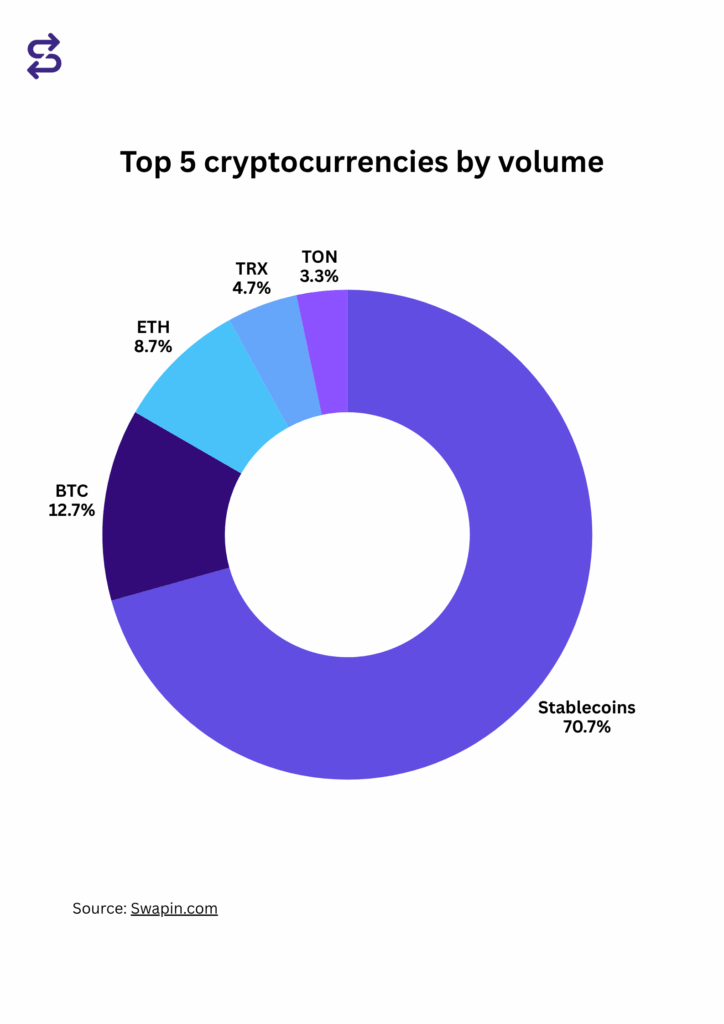
Two, people automatically think of BTC and ETH when you mention crypto payments, when in reality, Stablecoins are more commonly used for payments. As for the merchant, it really doesn`t matter which currency is used, they receive in fiat.
Between January 2023 and February 2025, businesses processed over $94 billion in stablecoin payments. And at Swapin, stablecoins is the most commonly processed cryptocurrency as well.
Q: What concerns keep businesses from accepting crypto payments? What was the deciding factor for businesses to move to the commitment stage?
Ivar: The main concerns I hear from clients are about compliance, volatility, and operational risk. Once that’s taken care of for them, they’re not hesitant and are rather eager to come onboard.
Q: How have the recent regulatory updates affected how businesses view/manage crypto payments? Did regulatory clarity help close deals better and faster?
Ivar: Most merchants aren’t too deeply familiar with crypto-related regulations, they focus on their core business. It’s like, if you buy a car, you don`t need to know how the engine works; you just want it to drive.
It’s the same when it comes to payment providers. The merchants want payment partners they can trust to take care of everything “under the hood”, so that everything just works how it’s supposed to work.
Zero-integration crypto payment gateways simplifying adoption
Q: Why is the crypto payment link the easiest starting point for companies accepting crypto for the first time?
Ivar: Because it removes the technical barrier. There’s no integration, no wallet setup, no custody, and no operational overhead required.
Businesses simply generate the payment link, share it with their customers, and receive EUR/USD. That simplicity is why most clients start here.
Q: How do you see stablecoins performing in 2026 compared to in 2025, especially since the regulatory developments and institutional adoptions.
Ivar: All current predictions point toward strong growth in stablecoin usage and the momentum from 2025 is expected to accelerate further. With clearer regulation and wider institutional adoption, 2026 will be the year of stablecoins.
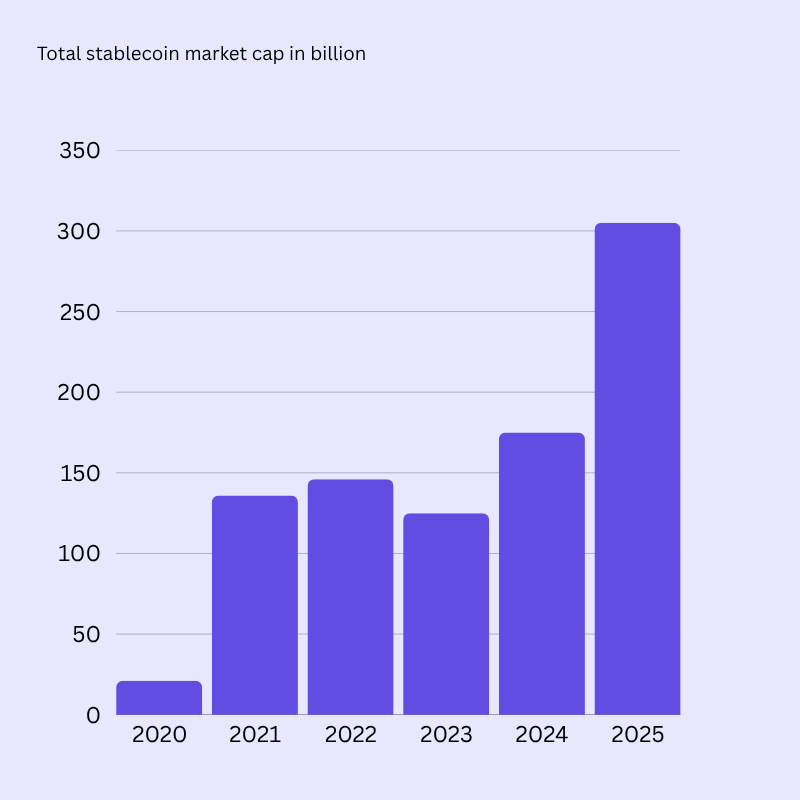
Currently, stablecoins total market cap is at $302 billion, and it’s only projected to grow. In fact, Citi Group predicts stablecoins base case estimate issuance to reach $1.9 trillion and $4.0 trillion in bull case by 2030.
Q: What trends and developments are you looking forward to in 2026?
Ivar: More companies are moving from treating crypto as a one-off exception to making it a normal part of their payment stack.
Instead of waiting for a client to specifically ask to pay in stablecoins, they are proactively offering it alongside traditional methods. It is becoming a built-in option, similar to card payments or bank transfers, because it helps them close deals faster, reach international clients more easily, and remove friction from high-value transactions.
Looking ahead: What to expect in 2026 for crypto payments
2025 marked a clear turning point that crypto payments are not a niche product for niche audiences.
Institutional adoption, regulatory clarity, and merchant adoption all point towards stablecoins becoming the norm. And in this case, simplicity wins. Businesses are looking for zero-integration, instant settlement options that don’t burden them with infrastructural responsibilities.
Learn more about how Swapin can help power your business transactions or get started today.