
How stablecoin processing solution help businesses scale in 2026
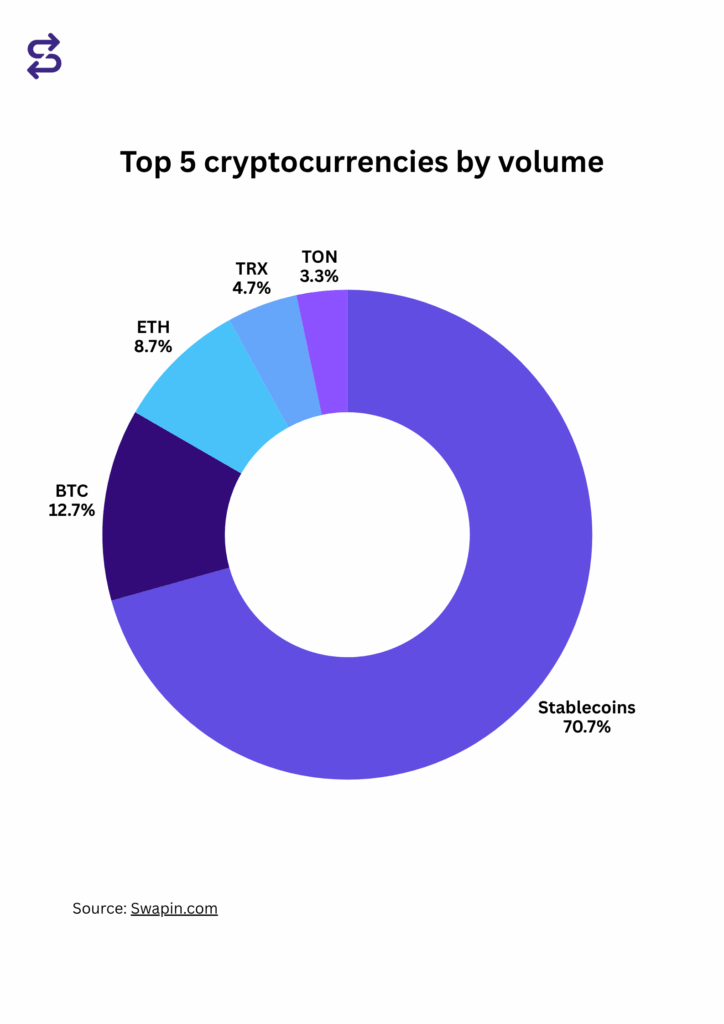
As per the stats, businesses processed over $94 billion in stablecoin payments between January 2023 and February 2025. Stablecoin started as an experimental checkout solution for crypto-native businesses but thanks to stablecoin processing solution, companies can now integrate stablecoins into their business alongside credit cards and bank transfers, especially for cross-border transfers.
As adoption grows, more companies are exploring how to accept stablecoin payments without taking on crypto volatility or building blockchain infrastructure from scratch. These platforms allow businesses to accept stablecoins from customers while settling funds directly into fiat accounts, simplifying operations and reducing risk.
The shift is reflected in consumer, business, and government behaviour as the push to regulate and adopt stablecoin payments increases globally.
In this blog, we cover:
- the top stablecoins in the market by trading volume and market cap
- the factors leading to stablecoin boom
- what makes stablecoins an ideal solution for businesses
- how stablecoins payment processors help
What is a stablecoin and how does a stablecoin processing solution work?
Stablecoins are cryptocurrencies pegged to traditional fiat currencies such as USD and EUR to maintain a fixed value. So unlike other cryptocurrencies where volatility is constant, stablecoins are, well, stable. Essentially, they’re digital currencies on the blockchain networks so you get the speed and global reach of crypto without the volatility risk.
A stablecoin processing solution allows businesses to accept payments in stablecoins while maintaining predictable settlement and operational simplicity.
So instead of building and managing infrastructure, wallets, and liquidity internally, merchants can partner with a payment processor that handles the technical and financial layers required to receive and settle stablecoin transactions.
A stablecoin processing solution, then:
- acts as the bridge between blockchain networks and traditional financial systems;
- receives, verifies, and settles payments made by the customer;
- converts and settles funds instantly into fiat currencies such as USD, GBP, or USD;
- allows merchants to accept payments in stablecoins while receiving the exact invoiced amount in fiat.
Stablecoin payment processing for merchants allows businesses to offer crypto payment options without taking on the operational complexity. They don’t need to manage private keys, monitor blockchain networks, or build conversion infrastructure themselves.
The payment processor manages these processes while providing a familiar payments interface, often through APIs, payment links, or checkout integrations.
What are the top 5 most popular stablecoins in 2026?
Stablecoins offer a hedge against volatility due to its fiat-backed system and speedy transfers. For this reason, it’s quickly becoming a crowd favourite.
Here are the top 5 stablecoins by market cap and trading volume:
1. Tether (USDT)
Launched in 2014, the original stablecoin still dominates the crypto ecosystem. In 2026, USDT’s market cap is $183.6 billion with over $100 billion daily trading volume.
2. USD Coin (USDC)
Issued by Circle and built on Ethereum, USDC is the second largest by market cap and third-largest by daily trading volume. USDC’s capability to integrate into the traditional financial system allows users to settle transactions in Visa’s network.
3. Ethena
USDe is pegged to Ethereum-based financial tools instead of traditional currencies and is the fourth largest by market cap.
4. DAI
Created by MakerDAO in 2017, DAI is a decentralised, crypto-collateralised stablecoin. Even though DAI’s market cap is well below those of USDC and USDT at $5.4 billion, it has the largest daily trading volume of $20.6 billion, making it the second largest.
5. PayPal USD
PUSD is the native stablecoin by PayPal. Even with most of the usage happening within the PayPal ecosystem, it is still the seventh-largest by market cap.
Factors contributing stablecoin payment adoption and expansion
1. Regulatory clarity
Regulatory compliance and frameworks around cryptocurrencies and stablecoins signal digital assets are no longer niche investment assets.
The EU’s MiCAR is the first major standardised approach to regulating digital assets and the service providers. Launched into effect from 2025, the regulation aims to provide legal clarity and simplify the regulatory landscape across the EU states.
In fact, as per a Fireblocks research, 35% European firms cite security as a top stablecoin benefit with 37% citing stronger fraud protection as a solution to faster adoption.
Similarly, in the US, the Genius Act ensures only Permitted Payment Stablecoin Issuers can issue or sell a US-pegged stablecoin.
2. Technological advancements
As stablecoins make their way into the mainstream, payment platforms and businesses are quick to integrate them and offer crypto owners a chance to spend their assets.
Stablecoin processing solution like Swapin makes it easier for businesses to accept crypto and stablecoins from clients worldwide while still receiving in USD, EUR, or GBP. Spending and accepting digital assets is now just as easy as fiat currencies.
3. Real world use cases
Taking away volatility risk opens up practical use cases such as remittances and international payments. International companies can now pay contractors and freelancers in stablecoins, no longer subjected to delays and excessive transfer and conversion fees. Stablecoins are also used as collateral as the reserves backing them are typically US treasuries.
4. Institutional inclusion
2025 saw financial institutions getting their hands on stablecoins starting with Stripe acquiring Bridge earlier this year. Soon after, Circle’s billion-dollar IPO signaled stablecoin’s arrival into the mainstream financial markets.
BlackRock launched IBIT that went on to become the most traded Bitcoin ETP of all time. Card networks Mastercard and Visa embraced crypto payments with Mastercard partnering with Circle for stablecoin settlements and Visa launching stablecoin-linked cards.
Why are businesses opting for stablecoin payments?
Last year, stablecoin transactions went up 106% with a total of $46 trillion in total transaction volume. There are three big reasons why stablecoins became the go-to cryptocurrency for businesses globally. It’s cost-effective, quick to settle, and available to access globally.
Benefit 1: Low processing cost
Credit card processing fees typically range anywhere between 1.5% to 3.5% and remittance fees can go up to 10%, the friction isn’t worth it for businesses. What’s more, international payment settlements can take up to 7 days with an average of five intermediaries, adding the total cost from anywhere between $14-to-$150 per $1,000 transfers.
Stablecoin payments allow users to bypass intermediaries, bringing down the processing cost and making the transfers practically free and instant.
Benefit 2: Near-instant bank settlement
When you remove the multiple intermediaries, the cost and time to settle reduces drastically. So payments that would otherwise take days, now take seconds to reach. Stablecoins by design are meant to deduct unnecessary time taken to reach from point A to point B.
It’s for this reason that remittances are the biggest use cases for stablecoins, especially for countries with volatile and inflated currencies. SpaceX, for example, uses stablecoins for cross-border payments in countries across Latin America, Africa, and Asia.
So businesses in the EU can receive instant payments from their clients based in the US without worrying about price volatility or delays.
Bringing us to our third benefit.
Benefit 3: Access to a global consumer base
Working with multiple currencies can slow down or even halt business operations. Stablecoins take away the hassle by giving individuals and businesses the opportunity to connect on a global platform.
The above mentioned pointers are the biggest reason why stablecoins lower the barriers for businesses entering the crypto space. Especially with solutions like crypto payment links, businesses don’t need to invest in a year-long development process.
The simple plug and play solution allows businesses to start accepting crypto from day 1 with zero integration and setup cost.
Key features to look for in a stablecoin payment solution
When evaluating a stablecoin payment processing for merchants, businesses should focus on infrastructure that simplifies operations while maintaining security and compliance.
Instant crypto-to-fiat settlement
The ability to automatically convert stablecoin payments into fiat currencies helps merchants avoid volatility and simplifies accounting.
Multi-chain support
Supporting multiple blockchain networks allows businesses to accept stablecoins across different ecosystems and customer wallets.
Compliance and regulatory controls
Built-in KYC, AML monitoring, and transaction screening help businesses meet regulatory requirements.
Merchant dashboard and reporting
Clear transaction visibility, settlement tracking, and reporting tools support reconciliation and financial oversight.
Flexible integrations
APIs, payment links, and checkout integrations make it easier for businesses to implement stablecoin payments without extensive development work.
How stablecoin processing solution allow businesses to scale
Swapin’s stablecoin payment processing for merchants allow businesses to accept stablecoin payments without any integration or setup fees.
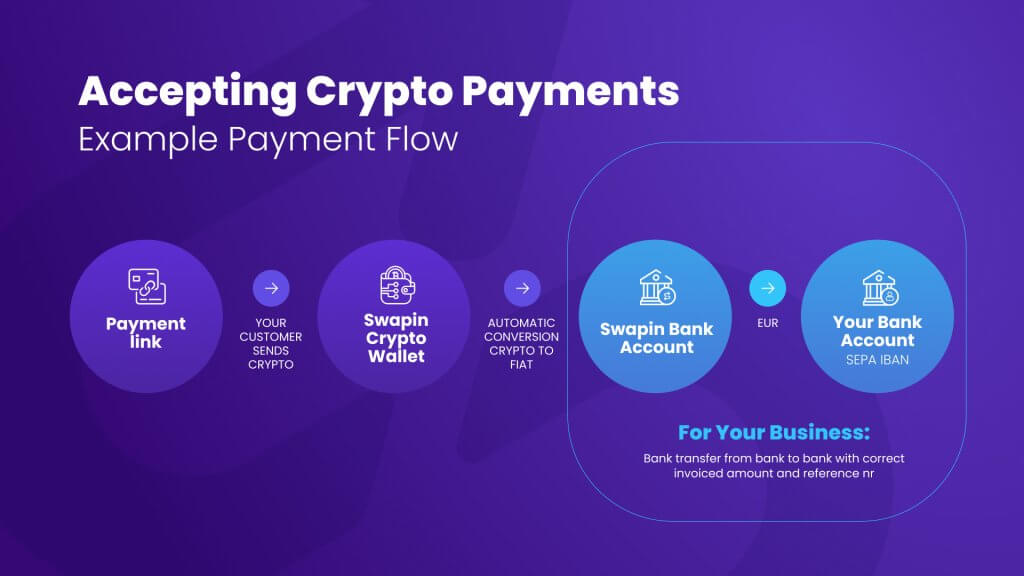
Here’s how the crypto payment link works:
Step 1: Issue an invoice with Swapin’s payment link and send it to your customer.
Step 2: The customer receives the invoice, clicks on the payment link redirecting them to the gateway where they pay with their preferred cryptocurrency.
Step 3: You receive the exact invoiced amount to your bank account in EUR, USD, or GBP.
How your business can benefit from accepting stablecoin payments:
→ Reach a growing customer base of 700M+ crypto owners worldwide ready to pay with crypto
→ Accept crypto without the hassle of handling or managing it
→ Real-time payouts made directly to your bank account
→ Zero integration required. Simply start accepting crypto payments from day 1
→ Eliminate volatility risk concerns as you always receive the exact amount in EUR
Learn more about how Swapin can help power your business transactions or get started today.
Frequently Asked Questions
What is a stablecoin processing solution?
A stablecoin processing solution enables businesses to accept stablecoin payments while managing the underlying blockchain transactions, settlement, and optional conversion into fiat currencies.
Can merchants accept stablecoins without holding crypto?
Yes. Many stablecoin processing solutions automatically convert incoming stablecoin payments into fiat currencies such as USD, EUR, or GBP, allowing businesses to avoid holding crypto.
Are stablecoin payments safe for businesses?
When implemented through regulated payment processors with compliance infrastructure, stablecoin payments can provide secure and transparent transactions recorded on blockchain networks.
How do stablecoin payments settle for merchants?
Once a customer sends a stablecoin payment, the transaction is confirmed on-chain. The processor then settles the funds either as stablecoins or converts them into fiat and transfers them to the merchant’s account.