
Accepting Payments in Crypto: Why Businesses Are Adopting Crypto Payments

Accepting payments in crypto is becoming part of how businesses manage global payments. Companies selling internationally often deal with high cross-border fees, delayed settlement, and payment infrastructure that varies widely across markets.
As of April 2025, the global cryptocurrency ownership is at 700 million users and projected to reach 962.92 million users worldwide by 2026. This marks a significant increase from 420 million users in 2023, highlighting substantial growth in adoption (Triple-A). Cryptocurrencies have transitioned from a niche investment to a widely accepted payment method for goods and services. This evolution is sparking interest among businesses to start accepting payments in crypto. Let’s dive into this trend and explore why an increasing number of merchants are considering crypto as a viable payment option.
Why are businesses accepting payments in crypto
Businesses are exploring crypto payments as payment infrastructure evolves beyond experimentation. What once required specialized wallets, manual settlement, and technical expertise can now be integrated into existing checkout systems through payment processors and gateways.
For companies operating internationally, crypto payments can simplify how value moves across borders. Transactions settle on blockchain networks within minutes rather than days, and payments are not limited by local banking hours or card network availability. This can improve cash flow while reducing operational friction in global transactions.
Crypto payments are predicted to grow at a compound annual growth rate (CAGR) of nearly 17% between 2023 and 2030 (Statista). This is driven by a variety of factors, including increasing consumer interest, technological advancements, and broader acceptance of cryptocurrencies.
Both merchants and consumers have grown more knowledgeable about crypto and confident in using it as a payment method. Global surveys indicate a high level of awareness about cryptocurrencies, with 92% of respondents out of a survey of 15,000 people in 15 countries across all continents stated they “have heard about them” (Consensys 2023).
A survey by Arlington Research for Kaspersky revealed that almost half of respondents (44%) believe that accepting payments in crypto will become a common choice for online shopping. Nearly 1 in 4 people would buy their groceries with crypto, 81% of gamers would use it to pay for game-related purchases, and 36% would use crypto to pay for dining and entertainment tickets.
Stablecoins have also accelerated adoption. Because they are designed to maintain a stable value relative to fiat currencies, businesses can accept crypto payments without exposure to the price volatility typically associated with digital assets. Payment processors can convert incoming crypto payments directly into fiat such as EUR, USD, or GBP, allowing businesses to benefit from blockchain settlement without holding crypto on their balance sheet.
Why stablecoins are accelerating crypto payment adoption
Stablecoins have addressed one of the main barriers that previously slowed crypto payment adoption: price volatility. Traditional cryptocurrencies can fluctuate significantly in value, which makes them difficult for businesses to use as a predictable payment medium.
Stablecoins are designed to maintain a consistent value by being pegged to fiat currencies such as the US dollar. This allows businesses to accept payments on blockchain networks while maintaining price stability similar to traditional currencies.
For merchants, stablecoin payments combine the efficiency of blockchain settlement with the predictability of fiat. Transactions can settle within minutes, cross-border transfers become simpler, and payment processors can automatically convert stablecoins into fiat currencies when funds are received.
In recent years, stablecoin payments have emerged as a compelling alternative to traditional payment methods, with major names like PayPal and Visa integrating them. Unlike more volatile cryptocurrencies like Bitcoin, whose price can swing dramatically, stablecoins are pegged to real-world assets, offering stability that appeals to traditional investors and businesses. Bernstein analysts noted in their latest report that just Q1 2024 value transferred stands at $6.8 trillion, nearly matching the 2022 high of $7 trillion. In 2024, stablecoins saw $27.6 trillion in transfer volume, which is 7.68% more than Mastercard and Visa combined.
Stablecoin transactions are expected to exceed $187 billion globally by 2028 (Juniper Research). This trend highlights the growing preference for stablecoins in facilitating transactions between businesses and customers.
Challenges and benefits of crypto payments
Challenges
While the buzz around crypto is growing, its adoption as an everyday payment method is still not mainstream. Major obstacles include:
One major obstacle is volatility, which can deter both merchants and customers. Crypto payment gateways, however, can automatically convert crypto into fiat like EUR during a purchase, mitigating volatility risk and ensuring that the merchant is receiving the exact invoiced amount in EUR and the customer was able to pay with desired crypto.
Regulatory clarity around cryptocurrencies is still lacking in many regions, which can cause hesitation among businesses. The introduction of new regulations like the Markets in Crypto Assets (MiCA) in the EU are helping to clarify legal ambiguities, making it easier for more businesses to integrate crypto payments.
Technical complexity is another challenge. Integrating crypto payments may seem complex and time consuming, but solutions like SwapinCollect simplify the process, allowing merchants to get started with invoicing customers within one business day.
Security remains a significant concern. In 2022, cryptocurrency hacks resulted in $3.7 billion stolen from users (Chainanalysis). While this figure decreased by 54.3% in 2023 to $1.7 billion, the threat persists as hackers are developing new ways to exploit exchanges and wallets. Crypto payment providers must invest in robust security measures to protect against breaches, and merchants must ensure they partner with licensed and security-focused providers.
Benefits
Despite these challenges, the crypto payments industry is evolving, more crypto-friendly businesses and eager consumers are emerging. Benefits of crypto payments are significant:
Crypto payments can reduce transaction costs significantly compared to traditional payment methods. Most cryptocurrency payment processors charge around 1% in fees, compared to up to 3.5% for credit card payments.
Blockchain transactions can be processed almost instantaneously, which is especially beneficial for international transactions that typically take several days through traditional banking systems.
Accepting cryptocurrencies can attract a new segment of customers that prefer to use digital currencies, expanding a business’s reach and boosting growth.
As cryptocurrencies gain more acceptance as a payment method, being an early adopter may provide a competitive edge and position you as an innovative brand.
Accepting payment in crypto as a business
Accepting crypto as payment can offer businesses a number of benefits:
- Meeting customer demand: More people want to pay in crypto, especially in regions with high crypto adoption rates
- Fast settlements: Blockchain technology enables fast transaction processing, carried out 24/7, reducing cash flow gaps for businesses
- Cost efficiency: Crypto transactions typically have lower fees than traditional payment methods, which can result in significant savings, particularly for businesses with high transaction volumes
- High average transaction value: Some industries report that the average deposit value for crypto can be 5-10x higher than for other payment methods
- Transparency: Blockchain transactions are final and traceable, eliminating the risk of fraud and the associated costs and administration
- Reliability: Leading cryptocurrencies have been proven over many years as a method for securely making transactions
- Easy adoption: Merchants can partner with crypto payment providers to make the process of accepting cryptocurrencies simple and straightforward
- Payer experience: While the crypto payment experience is still maturing, providers like Swapin make it easy for your users to complete the crypto payment process. You just provide an invoice and a payment link, they’ll know what to fill in, send crypto, and it’s done – Euros in your bank account!
When does accepting payments in crypto make sense?
Accepting payments in crypto is not necessary for every business, but it can be valuable in specific operating environments. Companies that sell globally, serve digital-first customers, or face high cross-border payment costs often see the most benefit.
For example, businesses that operate internationally can use crypto payments to reduce reliance on traditional banking rails and card networks. Settlement can happen faster, and payments are not restricted by regional payment infrastructure.
Accepting payments in crypto can also make sense for businesses that serve customers who already hold digital assets. In these cases, offering crypto at checkout simply adds another payment option alongside cards, bank transfers, and digital wallets.
In practice, crypto payments are most relevant for businesses that:
- Sell products or services globally
- Serve crypto-native or Web3 audiences
- Experience high cross-border transaction fees
- Operate in markets where traditional payment infrastructure is limited
For these companies, accepting payments in crypto can expand payment flexibility while improving how funds move across borders.
Ways businesses accept payments in crypto
Businesses can accept payments in crypto in several ways, depending on their technical resources and how they want payments to settle. Most companies choose infrastructure that integrates with their existing checkout systems rather than managing blockchain transactions directly.
Direct wallet payments
In this model, a business shares a crypto wallet address with customers, who then send funds directly from their own wallets. The transaction settles on a blockchain network and is recorded publicly.
While this approach is simple, it requires businesses to manage wallets, monitor transactions, and handle accounting for incoming crypto payments. It is most commonly used by smaller businesses or individual merchants.
Crypto payment gateways
Crypto payment gateways provide a structured way for businesses to accept payments in crypto through their checkout systems. The gateway processes the blockchain transaction, confirms payment, and manages settlement.
Many gateways also offer automatic conversion, allowing businesses to receive funds in fiat currencies such as EUR, USD, or GBP instead of holding crypto. This removes volatility exposure while still enabling customers to pay with digital assets.
Payment links and hosted checkout
Some payment providers offer crypto payment links or hosted checkout pages. Businesses generate a payment link that customers can open to complete a crypto transaction using their wallet.
This model is commonly used for invoices, service payments, or online purchases where a full checkout integration is not required. It allows businesses to accept crypto payments without building payment infrastructure from scratch.
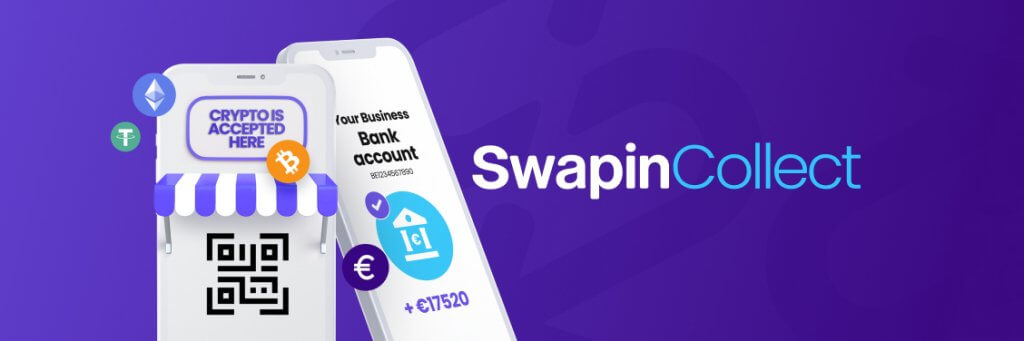
Accepting crypto as payment with SwapinCollect
If you’re considering crypto payments for businesses and are looking for an easy way to do so, SwapinCollect offers a great solution. Here’s how:
- Multi-currency support: Swapin supports various cryptocurrencies, including BTC, ETH, USDC, and more, providing flexibility for both merchants and customers.
- Fast transactions: All crypto payments are settled directly to your business’ SEPA bank account in EUR.
- Zero fees for your business: Free onboarding and set-up. The customer pays the transaction fees.
- Licensed provider: Swapin is a EU-regulated payment processor, ensuring the security of customer data and funds.
- Rate lock: Exchange rates are locked for 30 minutes during the payment process, ensuring your customers have time to complete their payment and your business receives the exact amount as invoiced.
- No chargebacks: Crypto payments cannot be reversed and are easily tracked on the blockchain.
- Personalized support: Our team of experts is always there to assist you with any questions
Frequently Asked Questions (FAQs)
Q: How many businesses accept crypto?
A: While it is difficult to get an accurate global total, around 30,000 merchants worldwide currently accept Bitcoin. Well-known brands include PayPal, Microsoft, Shopify, Starbucks, Twitch, Subway.
Q: What are the benefits of accepting cryptocurrency?
A: There are many benefits for merchants, including meeting customer payment preferences, settling funds fast, and lower processing costs compared to cards.
Q: What are the risks of crypto payments?
A: Risks include price volatility and navigating an inconsistent regulatory environment. Stablecoins are becoming popular for payments because they provide greater price stability.
Q: Can small businesses accept crypto?
A: Yes, any size business can accept crypto payments. Many crypto payment processors like Swapin offer solutions tailored to small businesses, making it easy to start.
Q: Can my business have a crypto wallet?
A: Yes, businesses can have custodial or non-custodial wallets, depending on their needs and how they prefer to manage their assets. Swapin is a non-custodial solution, so we don’t hold your funds, we immediately process payments for you
Crypto payments for businesses made simple
Cryptocurrencies are forecasted to become a mainstream payment method in the future, driven by their advantages in speed, cost, and accessibility. While challenges remain, particularly around regulations, the benefits for both consumers and businesses are substantial.
For businesses interested in accepting crypto as payment, SwapinCollect provides the tools and support necessary to make this transition smooth and secure, enabling businesses to tap into the growing market of crypto users and drive growth.
Learn more about SwapinCollect here and reach out to our team to get started today!